


Updated 15 October 2026 · General information, not legal or tax advice for a specific company.
The representative office vs subsidiary Vietnam decision usually turns on one question: will your company earn revenue in Vietnam? A representative office (RO) lets a foreign company build contacts, research the market and support its parent’s deals, but it cannot trade or invoice customers. A 100% foreign-owned subsidiary is a Vietnamese company that can sell, sign contracts and employ a delivery team, in exchange for full tax and accounting compliance.
This guide compares the two structures on the criteria that drive the decision. For registration steps, see our guide to company setup and business licensing for foreign investors.
Representative office vs subsidiary Vietnam: the short answer
Choose a representative office if, for now, you only need to learn the market, meet partners, promote the brand or follow up contracts your parent signs offshore, with every sale still invoiced by the parent outside Vietnam. An RO is not a separate legal entity: it acts for the parent, cannot carry out profit-generating business directly, and its compliance centres on personal income tax for its staff and reporting on its operations. Choose a subsidiary, usually a single-member limited liability company owned by the parent, if you will invoice Vietnamese customers, deliver services locally, import and distribute goods, or need contracts signed by a Vietnamese entity. The subsidiary has its own legal personality, charter capital and tax code, and carries the full set of obligations: corporate income tax, VAT, withholding taxes, bookkeeping, annual financial statements and a statutory audit under current regulations. If revenue in Vietnam is likely soon, setting up the subsidiary first is often simpler than opening an RO and closing it later.
What a representative office can and cannot do
Under Vietnam’s commercial law rules, an RO works as a liaison office for its parent. Typical permitted work includes:
- Liaison with customers, suppliers, partners and authorities on the parent’s behalf.
- Market research to identify opportunities for the parent’s goods and services.
- Promotion of the parent’s trade and investment projects in Vietnam.
- Follow-up on contracts the parent has signed with Vietnamese partners.
What it cannot do is the commercial core. It cannot carry out profit-generating business directly, sell goods or services in its own name, or issue sales invoices. Because the RO has no separate legal status, the parent company answers for what the office does.
The practical risk is drift. If RO staff negotiate prices, close sales or collect payments for the parent, the office is working outside its permitted scope, and the tax authorities may argue that the parent itself is doing business in Vietnam, with corporate income tax or foreign contractor tax exposure on that income. Keep sales authority with the parent.
What a 100% foreign-owned subsidiary can do
A subsidiary is a Vietnamese enterprise set up under the Law on Enterprises No. 59/2020/QH14 (as amended, including by Law No. 76/2025/QH15), together with the investment procedures that apply to foreign investors under the Law on Investment No. 143/2025/QH15, in force since 1 March 2026. Most foreign parents use a single-member limited liability company; a multi-member LLC or a joint stock company suits joint ventures or groups of investors.
Within its registered business lines, and any market access conditions for its sector, a subsidiary can:
- sign contracts, open bank accounts and lease premises in its own name;
- sell goods and services to Vietnamese and overseas customers and issue e-invoices;
- employ staff directly and build a local delivery team;
- earn profit, pay corporate income tax and remit after-tax profits to the parent under current regulations.
The owner’s liability is limited to the capital it contributes. The trade-off is a heavier compliance load from the first month, described below.
Side-by-side comparison of the two structures
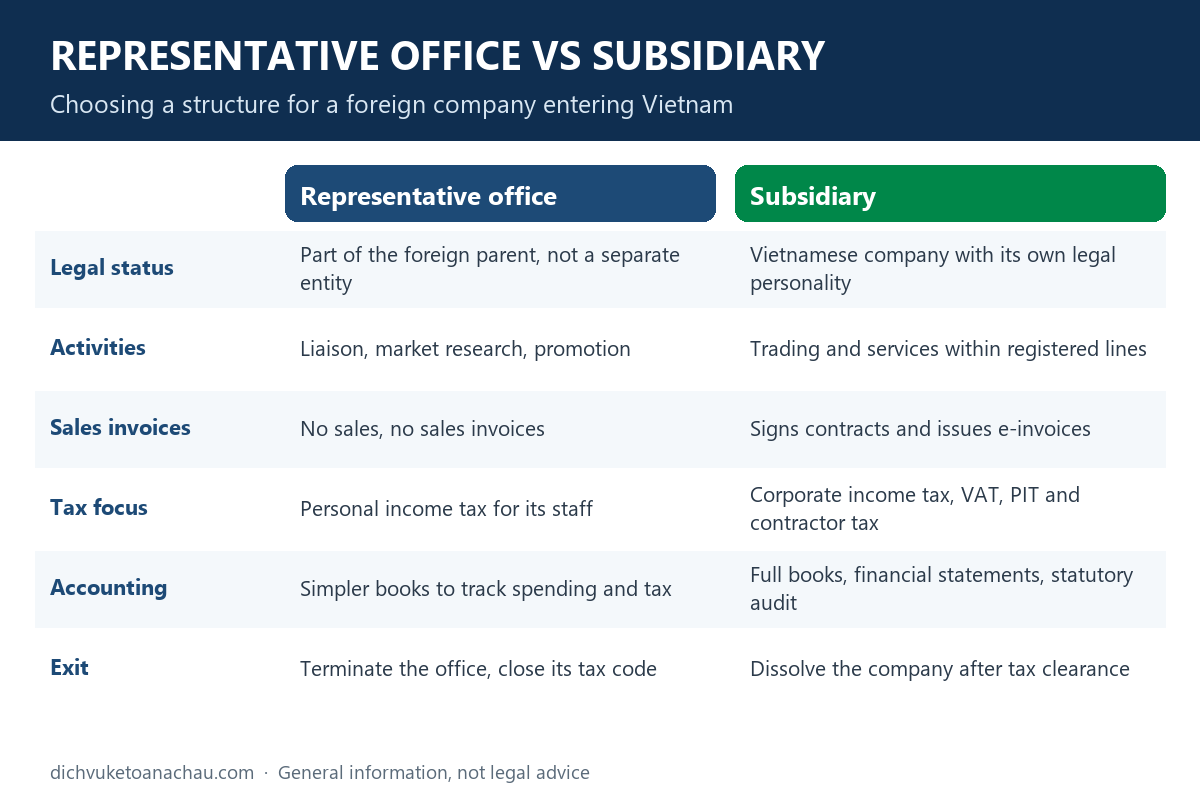
The table sets out the representative office vs subsidiary Vietnam comparison on the points that usually decide cost and risk.
| Criterion | Representative office | 100% foreign-owned subsidiary |
|---|---|---|
| Legal status | Dependent unit of the foreign parent; not a separate legal entity | Vietnamese legal entity with its own charter capital, seal and tax code |
| What it may do | Liaison, market research, promotion, follow-up of the parent’s contracts; no direct profit-generating business | Business within its registered lines, subject to market access conditions |
| Sales contracts and invoices | Does not sell or issue sales invoices; sales are contracted and invoiced by the parent | Signs contracts and issues e-invoices to its customers |
| Personal income tax (PIT) | Withholds and declares PIT for its employees | Withholds and declares PIT for its employees |
| Foreign contractor tax (FCT) | Not part of routine compliance; review case by case if the office pays a foreign party directly | Withholds FCT when it pays foreign contractors for services, royalties, interest or other income within FCT scope |
| Corporate income tax (CIT) | None in the ordinary course, because it earns no revenue | CIT on taxable profit, with an annual finalisation |
| VAT | Charges no output VAT; VAT on its purchases is generally a cost | Declares output VAT and deducts eligible input VAT |
| Accounting | Head of office decides accounting staffing; may apply the enterprise accounting regime to keep books for tax purposes | Full books, a chief accountant, annual financial statements and a statutory audit under current regulations |
| Reporting | Annual report on its operations to the licensing authority, plus PIT filings | Tax returns, financial statements and the other reports required of foreign-invested enterprises |
| Term | Operates under a licence with a fixed term, which can be extended before expiry if the office is to continue | The company has no expiry date; an investment project may carry its own operating term |
| Running cost | Lower: office, staff and payroll filings | Higher: bookkeeping, tax filings, audit, and capital to fund operations |
| Closing or converting | Terminate the office and close its tax code; no one-step conversion into a company | Dissolution, tax clearance and, where relevant, termination of the investment project |
Sales invoices are the clearest dividing line: in practice, a local subsidiary is the usual way to contract and issue VAT invoices locally.
How tax and accounting differ in practice
The Law on Accounting No. 88/2015/QH13 applies to representative offices of foreign enterprises as well as to companies (Article 2), but the detailed rules differ sharply.
Representative office
An RO registers for a tax code mainly to declare and withhold PIT for its staff. Tax registration and the closing of a tax code are governed by Article 10 of the Law on Tax Administration No. 108/2025/QH15, in force since 1 July 2026. Social insurance for eligible staff follows; see payroll and social insurance in Vietnam.
Its spending is funded by the parent, and its books mainly track those funds. Under Article 23 of Decree 174/2016/ND-CP, the head of the office decides who does the accounting, and the office may apply the enterprise accounting regime to keep books for tracking and determining its obligations to the state budget. A chief accountant is not mandatory.
Subsidiary
From incorporation, a subsidiary files VAT and PIT returns and pays and finalises CIT (see our corporate income tax guide). It withholds foreign contractor tax (FCT) when it pays foreign contractors for services, royalties, interest or other income within FCT scope. Dealings with the parent, such as fees, royalties and loans, fall under related-party rules.
On the accounting side, the subsidiary must appoint a chief accountant unless it qualifies as a micro enterprise; see our note on the chief accountant requirement in Vietnam. Vietnamese is the written language of accounting, and financial statements that use a foreign language must be bilingual (Law on Accounting, Article 11(1), as amended by Law No. 56/2024/QH15). Companies on the general enterprise regime follow Circular 99/2025/TT-BTC for financial years beginning on or after 1 January 2026. The annual audit tests all of it; see our FDI audit readiness checklist.
Which structure fits your situation?
Most representative office vs subsidiary Vietnam decisions follow one of these patterns:
| Your situation | Usual fit | Why |
|---|---|---|
| Exploring the market; no local customers yet; the parent invoices from abroad | Representative office | Low running cost; no local sales to tax |
| Supplier liaison and quality follow-up for the parent’s purchasing | Representative office, often | Liaison and contract follow-up are core RO work, if buying and payment stay with the parent |
| Selling to Vietnamese customers who want local contracts and VAT invoices | Subsidiary | In practice, a local subsidiary is the usual way to contract and issue VAT invoices locally |
| Hiring a team that delivers paid services in Vietnam | Subsidiary | Paid service delivery is business activity, which an RO cannot carry out |
| Importing and distributing goods | Subsidiary, subject to market access conditions | Trading rights depend on registered lines and sector conditions |
| Testing first, with sales expected soon after | Compare total cost both ways | An RO followed by a subsidiary means two set-ups and one closure |
Before deciding, check whether your sector carries market access conditions for foreign investors under the Law on Investment No. 143/2025/QH15, and whether customers or banks need a Vietnamese counterparty. This guide does not cover branches of foreign traders, which follow separate rules.
Moving from a representative office to a subsidiary
In practice there is no one-step conversion. The usual sequence is to set up the subsidiary, move staff and contracts across, then terminate the RO and close its tax code. Plan the overlap so payroll moves cleanly, and decide who keeps the RO’s accounting records after it closes.
Closing a subsidiary later is a bigger job: dissolution under Articles 207 to 211 of the Law on Enterprises, completion of tax obligations under Article 17 of Law No. 108/2025/QH15, and termination of the investment project under Article 36 of Law No. 143/2025/QH15 where one exists. Our guide to closing a company in Vietnam walks through the sequence. If you are reorganising an existing set-up, our business restructuring advisory team can compare the routes first.
Service fees
Whichever way the representative office vs subsidiary Vietnam choice falls, the books must be right from day one. Our accounting package starts from VND 500,000/month; the actual fee depends on invoice volume and scope, such as payroll, bank accounts and reporting needs. For a subsidiary, it covers bookkeeping, tax returns and financial statements through our accounting outsourcing services in Vietnam; for an RO, mainly PIT and payroll records. Advice on structure and related-party questions is quoted after we review your plans, through our tax consulting service. Call 0776 112 333 or use the form below.
Still weighing a representative office against a subsidiary?
Leave your details and an adviser will contact you and send a written quote.
Frequently asked questions
Can a representative office in Vietnam issue invoices or earn revenue?
No. A representative office cannot carry out profit-generating business directly, so it does not sell or issue sales invoices. Sales are invoiced by the parent abroad or by a Vietnamese subsidiary.
Does a representative office pay corporate income tax?
Not in the ordinary course, because it earns no revenue. It does register for a tax code and withholds and declares personal income tax for its staff. If the office drifts into sales activity, the parent may face tax exposure on that income.
How do accounting obligations differ between a representative office and a subsidiary?
A subsidiary keeps full books, prepares annual financial statements and must appoint a chief accountant unless it is a micro enterprise; see our guide to the chief accountant requirement in Vietnam. A representative office has a lighter regime: under Article 23 of Decree 174/2016/ND-CP, its head decides how accounting staff are arranged, and it may apply the enterprise accounting regime to keep books for tracking its tax obligations.
Can a representative office be converted into a subsidiary?
Not in one step. The usual route is to set up a new company, transfer staff and operations to it, then terminate the representative office and close its tax code.
Is a subsidiary always more expensive to run?
Usually, yes. It needs bookkeeping, regular tax filings, annual financial statements and a statutory audit under current regulations. The extra cost buys the right to trade and earn profit in Vietnam.
Related services: Accounting outsourcing · Chief accountant and accounting staff outsourcing · Tax consulting in Vietnam · FDI and transfer pricing tax advisory
Related Guides: Company setup for foreign investors · Chief accountant requirement in Vietnam · Closing a company in Vietnam · Corporate income tax in Vietnam · Foreign contractor tax in Vietnam · Payroll and social insurance in Vietnam
More English guides: Accounting and tax guides for foreign companies in Vietnam
Achau Accounting · 343 Pham Ngu Lao, Ben Thanh Ward (former District 1), Ho Chi Minh City · +84 776 112 333 · linhcskh@dichvuketoanachau.com

