


Updated 16 October 2026 · General information, not tax advice for a specific company.
The deductible expenses Vietnam CIT rules decide how much of your real spending the tax authority will accept. An expense in your audited accounts can still be added back to taxable income at finalisation or inspection, usually because one document or condition is missing. This guide covers the three conditions, the cost groups most often disallowed in foreign-invested companies, and the records that defend a deduction.
For rates, incentives and the filing calendar, see our corporate income tax guide for FDI companies.
What expenses are deductible for CIT in Vietnam?
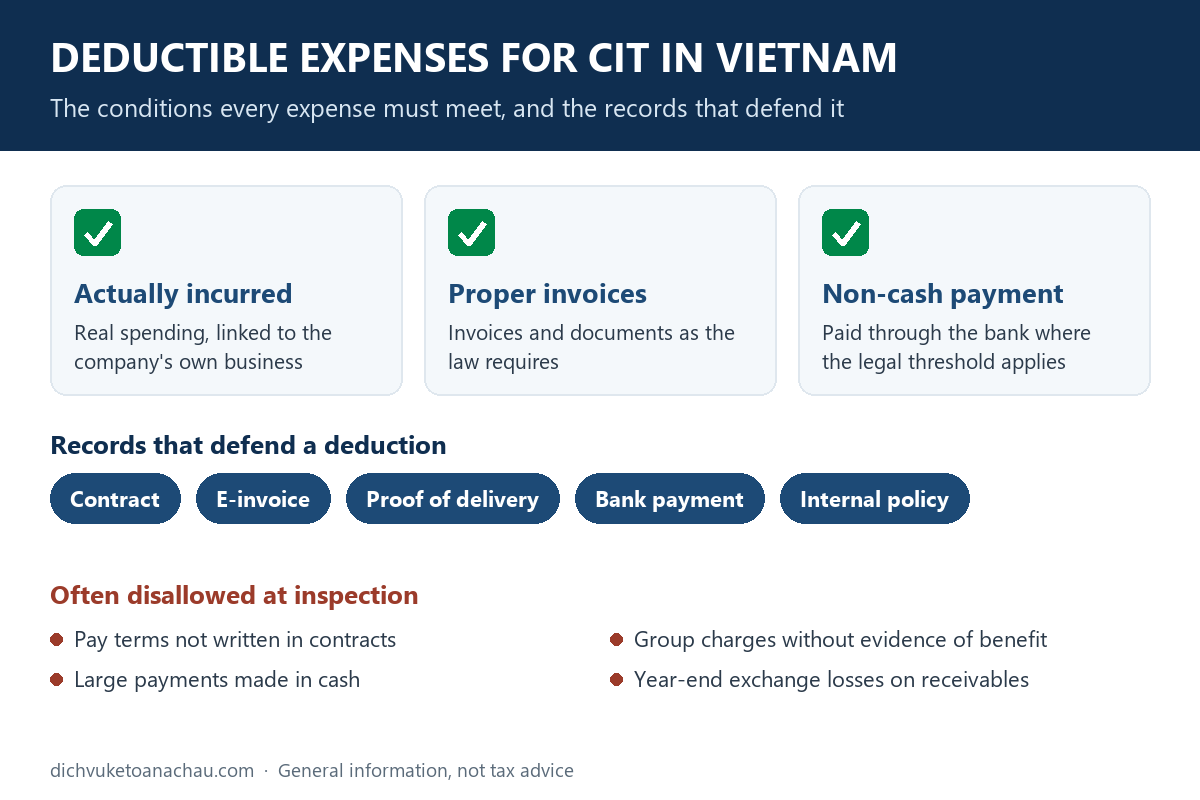
Under Article 9 of the Law on Corporate Income Tax No. 67/2025/QH15, in force since 1 October 2025 and applied from the 2025 tax year, and Article 9(1) of Decree 320/2025/ND-CP, an expense is deductible when it meets three conditions together. It must be actually incurred and related to the company’s business. It must be supported by invoices and documents as required by law. And where a purchase or other payment is VND 5 million or more per transaction, it needs non-cash payment documents (Article 9(1)(c) of the Decree). Meeting all three is necessary but not sufficient: Article 9(2) of the Law and Article 10 of the Decree list expenses that stay non-deductible anyway, such as fines, late-payment interest, depreciation outside the rules, excess provisions, and the part of certain costs above a Government cap. In practice, most disallowances come from missing paperwork rather than from the nature of the expense.
Deductible expenses Vietnam CIT: the three conditions
Decree 320/2025/ND-CP, in force since 15 December 2025, replaced Decree 218/2013/ND-CP; its non-cash payment rule applies from that date. Each condition below is a legal requirement.
1. Actually incurred and linked to the business
Inspectors ask what was received and who used it; a consultant’s invoice with no report, deliverable or contract is the classic failure. Expenses that do not correspond to taxable revenue are excluded (Decree 320/2025, Article 10(22)), although the Decree accepts some costs incurred before revenue exists, such as unsuccessful tenders, company formation costs and pre-launch marketing, if the supporting records are kept (Article 9(2)(i)).
2. Invoices and documents as required by law
For most purchases this means a valid e-invoice issued under Decree 123/2020/ND-CP as amended by Decree 70/2025/ND-CP, showing the company’s name and tax code. The invoice starts the file but does not finish it; see our e-invoice compliance guide for invoice errors and replacements.
3. Non-cash payment for VND 5 million or more
Each purchase or other payment of VND 5 million or more needs a non-cash payment document, typically a transfer from the company’s bank account. Decree 320/2025 closes the obvious gaps:
- Split purchases: several purchases from the same seller on the same day are added together; if the total reaches VND 5 million, non-cash payment is required (Article 9(1)(c1)).
- Employee payments: an employee may pay by card or another non-cash method for the company if an internal policy or decision authorises it, the invoice is in order and the company reimburses the employee (Article 9(1)(c2)).
- Unpaid invoices: see the FAQ below on purchases still unpaid when the expense is recorded (Article 9(1)(c3)).
Older guidance quoting a different threshold is out of date. As good practice, pay every supplier by bank transfer from the company’s own account, whatever the amount.
Ten costs FDI companies most often lose at finalisation
The table groups the items where a deductible expenses Vietnam CIT review most often ends in an add-back. References are to Article 10 of Decree 320/2025/ND-CP unless stated otherwise.
| Expense group | Why it is disallowed | Records to keep |
|---|---|---|
| Salaries and bonuses | Terms not written in the labour contract, secondment letter, collective agreement, financial regulation or bonus policy; or accrued but unpaid by the finalisation deadline (Art. 10(8)) | Contracts or secondment letters, bonus policy, signed payroll, bank payment records, PIT filings |
| Expatriate housing and school fees | Not written into the labour contract, or invoices not in order (Art. 10(8)(b)) | Labour contract clause, invoices, payment proof |
| Taxes borne for others | PIT paid for staff is deductible only under a net-salary contract; CIT paid for a foreign contractor only if its contract revenue is net of CIT (Art. 10(12)) | Net-of-tax contract clauses, tax returns, payment slips |
| Purchased and intra-group services | No evidence the service was actually received and used for the business (a contract, acceptance record or deliverable is the usual proof); related-party price not at arm’s length | Contract, service reports, acceptance minutes, allocation keys, transfer pricing file |
| Cash payments | VND 5 million or more paid without non-cash proof (Art. 9(1)(c)) | Bank transfer records, policy on employee card payments |
| Staff welfare | The part above one month’s average actual salary for the year, covering items such as holidays, medical support and family events (Art. 10(4)(d)) | Welfare policy, beneficiary lists, invoices |
| Voluntary pension and life insurance | The part above VND 5 million per person per month; terms not set out in a contract or policy; none deductible while compulsory insurance is unpaid (Art. 10(4)(đ)) | Policy terms, insurer contracts, social insurance payment records |
| Depreciation | Assets not used for the business, without ownership papers or off the register; rates outside Ministry of Finance rules; for cars of up to nine seats, the cost above VND 1.6 billion, with exceptions such as transport and tourism businesses (Art. 10(6)) | Fixed asset register, ownership papers, depreciation schedule |
| Provisions, accruals and exchange losses | Provisions outside the provisioning rules; accruals unused at the end of their term; losses from year-end revaluation of foreign-currency cash, deposits and receivables (Art. 10(5), (7), (16)) | Provision workings, accrual reversals, revaluation workings by item |
| Interest, fines and sponsorship | Interest matching charter capital not contributed on schedule; interest to lenders other than credit institutions above the Civil Code limit; fines and late-payment interest; non-qualifying sponsorship; golf memberships (Art. 10(2), (8)(l), (9), (10), (17)) | Capital contribution records, loan agreements, sponsorship documents |
Payments to the parent company and other related parties
Group charges are often the largest single exposure under the deductible expenses Vietnam CIT rules. A management fee, IT recharge, shared-service allocation or royalty must meet the same three conditions as any other cost, and it is also tested under the related-party rules in Decree 255/2026/ND-CP. In an inspection, expect to show:
- a written agreement describing the services and charging basis, ideally signed before the service period;
- evidence that the services were received and benefited the Vietnamese company, such as reports, deliverables and time records;
- an allocation key reflecting actual use, and an arm’s length price; see what changed for related-party transactions under Decree 255/2026;
- foreign contractor tax withheld where the payment falls within its scope; see foreign contractor tax in Vietnam.
Up-front payments for technical documentation, patents, technology transfer licences, trademarks or brand-use rights that are not fixed assets are spread over no more than three years (Article 10(15)(b) of Decree 320/2025). Interest paid by a company with related-party transactions is also limited by the cap in Decree 255/2026/ND-CP; our note on the EBITDA-based interest cap explains how it works.
Payroll and expatriate costs: where the paperwork decides
Payroll rules are mostly about where the terms are written. Salaries, wages and bonuses are deductible only if the entitlement and amount appear in a labour contract, a collective labour agreement, the financial regulation or a bonus policy issued under it. For foreign staff transferred within a group, Article 10(8)(b) of Decree 320/2025 also accepts the document from the foreign enterprise sending the employee to Vietnam, so a clear secondment letter matters. Three further points cause most expatriate add-backs:
- School fees for an expatriate’s children studying in Vietnam, from kindergarten to upper secondary level, and housing paid by the company are deductible when written into the labour contract, salary-like in nature and supported by invoices.
- PIT paid by the company for an employee is deductible only where the labour contract sets a net salary that excludes PIT (Article 10(12)).
- Salary accrued at year-end but unpaid when the finalisation deadline passes is not deductible, unless it sits within a salary reserve made under Article 10(8)(c).
The same documents drive PIT and social insurance; see our payroll and social insurance guide.
Building an evidence file that survives an inspection
Inspectors review expenses one by one, often years later. Under the deductible expenses Vietnam CIT rules, the defence is a consistent file for each material expense, and it helps to separate what the law requires from good practice.
| Required by law for a deduction | Good practice that makes the file defensible |
|---|---|
| Invoices and documents as required (Law 67/2025, Art. 9(1)) | A contract and acceptance record for every service purchase |
| Non-cash payment proof from VND 5 million | One folder per supplier and year: contract, invoice, delivery evidence, bank payment |
| Pay, bonus and benefit terms written in a contract or policy | A quarterly review against the ten groups above |
| Internal policies the Decree relies on, such as employee card payments | A schedule reconciling accounting profit to taxable income |
A non-deductible expense stays in your financial statements; it is added back to taxable income in the CIT finalisation return, so keep the reconciliation. For an outside view of your files, see our FDI audit readiness checklist and bookkeeping review guide.
What a disallowed expense costs
When an item fails the deductible expenses Vietnam CIT tests, taxable income rises by its full amount. That costs the CIT on it plus late-payment interest from the original due date under the Law on Tax Administration No. 108/2025/QH15, in force since 1 July 2026, and administrative penalties may apply under current regulations. Where non-cash payment proof is missing, input VAT on the same purchase may also be at risk under the Law on VAT No. 48/2024/QH15.
Correcting an error through a supplementary declaration before an inspection is generally better than waiting, because late-payment interest keeps running. Our guide to tax risk management for foreign enterprises covers what triggers an inspection.
Service fees
Accounting packages start from VND 500,000/month; the fee depends on invoice volume, payroll size and reporting needs, through our accounting outsourcing services in Vietnam. A deductible expenses Vietnam CIT review before year-end, a corporate tax finalisation or inspection support is quoted after we review your records, through our tax consulting service or tax risk management advisory. Call 0776 112 333 or use the form below.
Worried that some expenses will be disallowed at finalisation?
Leave your details and an adviser will contact you and send a written quote.
Frequently asked questions
Is a valid e-invoice enough to make an expense deductible?
No. The invoice covers only the documentation condition. The expense must also be incurred for the business, paid by non-cash means where it reaches VND 5 million, and outside the exclusions in Article 10 of Decree 320/2025/ND-CP.
Can an employee pay a business expense with a personal card?
Yes, for purchases of VND 5 million or more, if a company policy or decision allows it, the invoice is in order and the company reimburses the employee (Article 9(1)(c2)). Similar conditions apply to business travel costs under Article 10(8)(h).
Are management fees charged by the foreign parent deductible?
They can be, if the services were actually received and benefit the Vietnamese company, the agreement and evidence exist, the price is at arm’s length under Decree 255/2026/ND-CP, and foreign contractor tax is handled where it applies. Charges without that evidence are a common inspection target.
Are unrealised exchange losses deductible?
Losses from revaluing foreign-currency cash, deposits and receivables at year-end are not deductible (Article 10(16)). That exclusion does not cover revaluation losses on foreign-currency payables, so keep the workings separated by item.
What if a supplier invoice is still unpaid when you record the expense?
For a purchase of VND 5 million or more that is unpaid when recorded, you may deduct it. If any part is later paid without non-cash proof, reduce expenses by that part in the period of payment, even if a tax inspection or audit decision already covers the period in which the expense was recorded (Article 9(1)(c3) of Decree 320/2025).
Related services: Tax consulting in Vietnam · FDI and transfer pricing tax advisory
Related Guides: Corporate income tax in Vietnam · Interest cap under Decree 255/2026 · Related-party transactions under Decree 255/2026 · Tax risk management for foreign enterprises
More English guides: Accounting and tax guides for foreign companies in Vietnam
Achau Accounting · 343 Pham Ngu Lao, Ben Thanh Ward (former District 1), Ho Chi Minh City · +84 776 112 333 · linhcskh@dichvuketoanachau.com

