


Updated 16 October 2026 · General information, not legal or tax advice for a specific company.
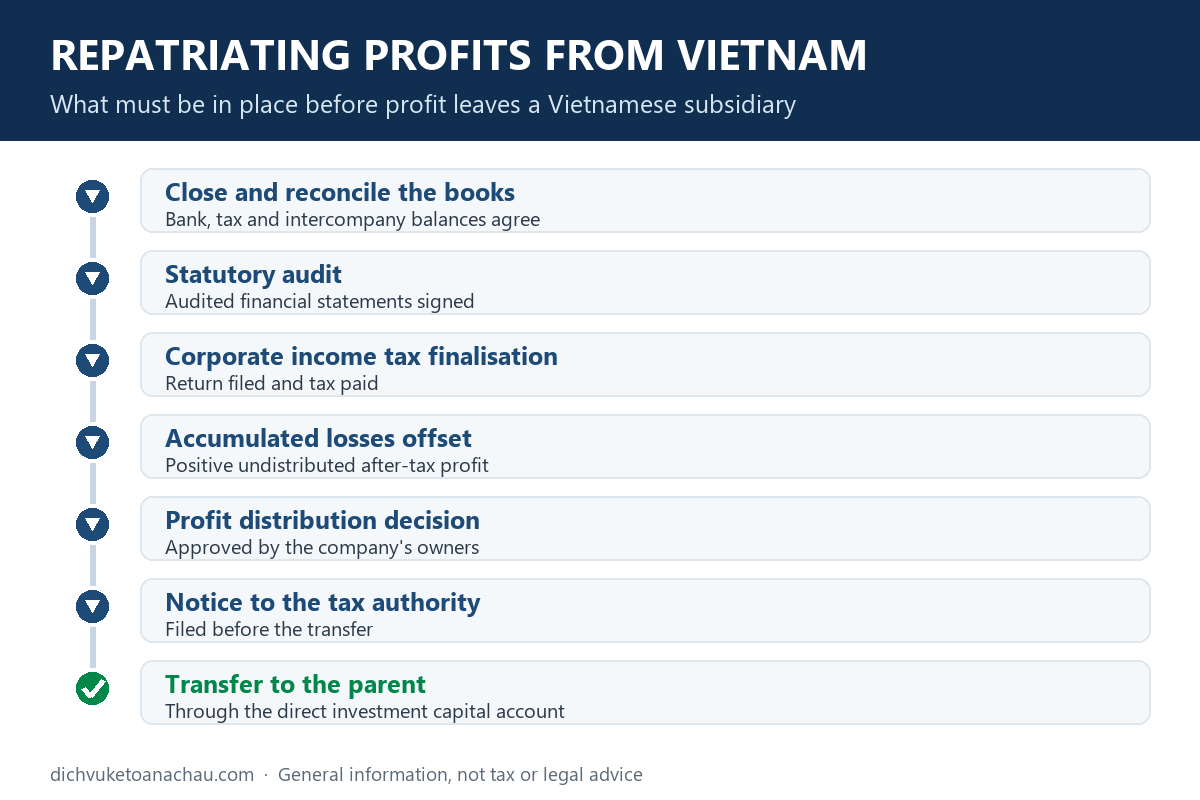
Repatriating profits Vietnam subsidiaries have earned is routine for foreign groups, but the cash leaves only once the books prove the profit exists. In practice that means a closed financial year, audited financial statements, a filed corporate income tax (CIT) finalisation, no accumulated losses, a formal profit decision by the owner, notice to the tax authority, and a transfer through the company’s direct investment capital account.
This guide is for CFOs of foreign-invested companies and their parents: the conditions, the documents, the accumulated-loss trap, and how profit compares with fees, royalties and interest. For the tax on profit itself, see our corporate income tax guide for FDI companies.
Repatriating profits Vietnam: can a foreign investor remit profits, and on what conditions?
Yes. Vietnam’s investment rules allow foreign investors to transfer lawful income from business investment abroad once their financial obligations to the Vietnamese State have been met. In practice, a foreign-owned company can remit after-tax profit to its parent when six things are in place. First, the financial year has closed and the annual financial statements have been audited. Second, the annual CIT finalisation return has been filed and the tax paid. Third, accumulated losses have been fully offset, so the balance sheet shows positive undistributed after-tax profit. Fourth, the owners have formally decided to distribute that profit, and the company can still pay its debts as they fall due afterwards. Fifth, the company has notified the tax authority of the planned remittance. Sixth, the money moves through the company’s direct investment capital account. The third, fifth and sixth conditions rest on current Ministry of Finance and State Bank of Vietnam guidance, so check the latest text before remitting. Remittance is an annual exercise, not a monthly cash sweep.
The conditions in detail: legal requirements and good practice
Separate what the rules require from what simply prevents delays.
Required by law or by current Ministry of Finance and State Bank of Vietnam guidance
- Tax and financial obligations met. Under the Law on Enterprises No. 59/2020/QH14 (as amended, including by Law No. 76/2025/QH15), a company may distribute profit only after meeting its tax and other financial obligations, and only if it can still pay its debts and other liabilities as they fall due after the distribution. On the tax side, the annual CIT finalisation is filed under the Law on Tax Administration No. 108/2025/QH15 and the tax is paid.
- Audited financial statements. Foreign-invested enterprises have their annual financial statements audited under current regulations; the audited undistributed after-tax profit is the starting point.
- No accumulated losses. For limited liability companies, under current Ministry of Finance guidance (check the latest text before remitting), profit is remitted only out of positive undistributed after-tax profit, after earlier losses have been offset. For joint stock companies, the Law on Enterprises also requires earlier losses to be covered before dividends are paid.
- A formal distribution decision. By the owner, the members’ council or the shareholders, depending on the company type, stating the amount and the financial year.
- Notice to the tax authority. Under current Ministry of Finance guidance (check the latest text before remitting), the company notifies its managing tax authority before the transfer.
- Transfer through the direct investment capital account. Under current State Bank of Vietnam foreign exchange guidance (check the latest text before remitting), foreign-invested enterprises that hold a direct investment capital account receive capital and remit profit through that account.
Good practice that prevents delays
- Reconcile undistributed profit to the CIT return before drafting the decision.
- Clear intercompany balances with the parent and complete related-party disclosures under Decree 255/2026/ND-CP before the auditor signs.
- Check that contractor tax was withheld on every fee, royalty and interest payment to the parent.
- Ask the bank for its document checklist early; banks add their own requirements.
Repatriating profits Vietnam checklist: documents, owners and risks
Before repatriating profits Vietnam operations have generated, give every item below an owner well ahead of year-end, so nothing waits on someone else when the audit closes.
| What must be in place | Who usually prepares it | What the bank or tax office looks for | Risk if it is missing |
|---|---|---|---|
| Books closed and reconciled | Chief accountant or outsourced team | Balances agreeing to bank, tax and intercompany records | Late audit adjustments change the profit available |
| Audited annual financial statements | Independent auditor | Audit report and undistributed after-tax profit | No evidence of distributable profit |
| CIT finalisation filed and tax paid | Company’s accountant or tax adviser | Filed return, proof of payment, no tax debt | Obligations not met; remittance cannot proceed |
| Accumulated losses fully offset | Chief accountant | Positive undistributed after-tax profit | Nothing to remit, even in a profitable year |
| Profit distribution decision | Parent company, members’ council or shareholders | Signed decision with amount and financial year | Authority for the payment questioned |
| Notice of remittance to the tax authority | Company or its tax agent | Notice filed in the required form and period | Transfer delayed or challenged later |
| Capital and account records | Finance team with the bank | Capital contributed as registered | Bank holds the transfer |
| Related-party and contractor tax files | Tax adviser and chief accountant | Related-party disclosure; contractor tax on payments abroad | Later adjustments cut distributable profit |
Our FDI audit readiness checklist covers the audit side in more depth.
Accumulated losses: why profitable groups still cannot remit
The most common obstacle to repatriating profits Vietnamese subsidiaries have earned is the balance sheet, not tax. Many foreign-invested companies make losses in their first years, from set-up costs, ramp-up and depreciation. Later profit first absorbs those losses; until undistributed after-tax profit turns positive, there is nothing to remit, even in a profitable year.
Two different losses are often confused:
- Accumulated accounting loss sits in equity on the balance sheet under Vietnamese Accounting Standards. It decides whether profit can be distributed.
- Tax loss carried forward sits in the CIT return. It reduces future taxable income within the period allowed by the Law on Corporate Income Tax No. 67/2025/QH15, but it does not by itself create distributable profit.
The two rarely match, so a company can pay CIT while still carrying an accounting loss. Map when the loss should be absorbed, and check whether charges from the parent keep the subsidiary in loss. Where the loss reflects a changed business plan, a capital restructuring may be worth assessing with our business restructuring advisory team.
When in the year can profits be remitted?
For most groups, profit repatriation is an annual exercise built around the audit. The usual sequence is:
- Close and reconcile the books for the financial year.
- Complete the statutory audit and sign the financial statements.
- File the CIT finalisation and pay any tax due.
- Approve the profit distribution decision.
- Notify the tax authority of the planned remittance.
- Instruct the bank to transfer through the direct investment capital account, with the supporting documents.
A late audit pushes everything else back. Groups that need cash earlier use other payments to the parent, each with its own tax cost (next section). When an investment ends, remaining capital and profit return after tax clearance; see closing a company in Vietnam.
Profit remittance vs fees, royalties and interest
Profit is only one way cash reaches the parent. The others can be deductible for the subsidiary, but carry withholding and documentation obligations.
| Route | When it is used | Vietnamese tax points to check | Main risk |
|---|---|---|---|
| Profit remittance | After-tax profit, after year-end | CIT already paid by the subsidiary; investor-level treatment depends on investor type and any tax treaty | Blocked by losses or missing documents |
| Management or service fees | Services the parent actually provides | Foreign contractor tax withheld by the payer; CIT deductibility; related-party pricing under Decree 255/2026/ND-CP | Expense disallowed if the benefit is not evidenced |
| Royalties | Use of the group’s brand or technology | Foreign contractor tax; related-party pricing; deductibility conditions | Challenged as profit shifting |
| Interest on shareholder loans | Parent funds the subsidiary by loan rather than equity | Foreign contractor tax on interest; the interest cap under Decree 255/2026/ND-CP; State Bank of Vietnam rules on foreign loans | Interest above the cap is not deductible in that period; carry-forward rules under Decree 255/2026 apply (see our EBITDA cap guide) |
| Return of capital | Capital reduction or exit | Law on Enterprises procedures and investment registration updates | Not a substitute for profit; strict conditions |
For the detail, see foreign contractor tax in Vietnam and what changed for related-party transactions under Decree 255/2026. The mix is a question for our FDI and transfer pricing tax advisory team: a fee later disallowed raises CIT and cuts the profit left to remit.
Keeping the books remittance-ready all year
Problems with repatriating profits Vietnam-based subsidiaries have earned are usually accounting problems found late. Companies on the general enterprise regime keep their books under Circular 99/2025/TT-BTC for financial years beginning on or after 1 January 2026. Vietnamese is the written language of accounting, and financial statements that use a foreign language must be bilingual (Law on Accounting No. 88/2015/QH13, Article 11(1), as amended by Law No. 56/2024/QH15). Habits that keep the year-end clean:
- reconcile intercompany balances monthly;
- track capital contributions against the registered schedule;
- review contractor tax on each payment abroad;
- keep the related-party file current;
- review provisional CIT payments each quarter.
Our accounting outsourcing services in Vietnam cover monthly bookkeeping and reporting, our corporate tax finalization service handles the year-end CIT return, and chief accountant outsourcing fills the statutory role.
Service fees
Most delays in repatriating profits from Vietnam trace back to the books. Our accounting packages from VND 500,000/month are priced by invoice volume and scope, such as payroll, bank accounts and English reports for the parent. CIT finalisation, remittance preparation and related-party advice are quoted after we review your accounts, through our tax consulting service. Call 0776 112 333 or use the form below.
Planning to remit profits from your Vietnamese subsidiary?
Leave your details and an adviser will contact you and send a written quote.
Frequently asked questions
Can profits be remitted before the annual audit is finished?
In practice, no. The distributable figure is the undistributed after-tax profit in the audited financial statements, after the CIT finalisation. Until both are done there is no reliable figure to remit.
Is more tax due in Vietnam when profits are sent to the parent?
Remitted profit is after-tax profit, taxed at the subsidiary’s corporate income tax rate, including any incentives it enjoys. Whether any further Vietnamese tax applies depends on whether the investor is a company or an individual and on any applicable tax treaty; confirm the treatment under the rules in force before you remit.
Can we remit profit while earlier accumulated losses remain?
No. Under current Ministry of Finance guidance (check the latest text before remitting), profit is distributable only once accumulated losses on the balance sheet have been offset and undistributed after-tax profit is positive. A profitable current year is not enough if earlier losses have not yet been absorbed.
Which bank account is used to remit profits?
Under current State Bank of Vietnam foreign exchange guidance (check the latest text before remitting), foreign-invested enterprises that hold a direct investment capital account remit profit through that account. The bank checks the audited financial statements, tax records and distribution decision before releasing the transfer.
What happens if the tax authority later adjusts a year whose profit was already remitted?
The company pays any additional tax, late-payment interest and any administrative penalty under the Law on Tax Administration No. 108/2025/QH15. Because the adjustment also reduces distributable profit, groups often keep a buffer and remit only after related-party and expense positions are reviewed.
Related services: Accounting outsourcing · Corporate tax finalization · Tax consulting in Vietnam · FDI and transfer pricing tax advisory · Business restructuring advisory
Related Guides: Closing a company in Vietnam · Representative office vs subsidiary in Vietnam · Company setup for foreign investors
More English guides: Accounting and tax guides for foreign companies in Vietnam
Achau Accounting · 343 Pham Ngu Lao, Ben Thanh Ward (former District 1), Ho Chi Minh City · +84 776 112 333 · linhcskh@dichvuketoanachau.com

