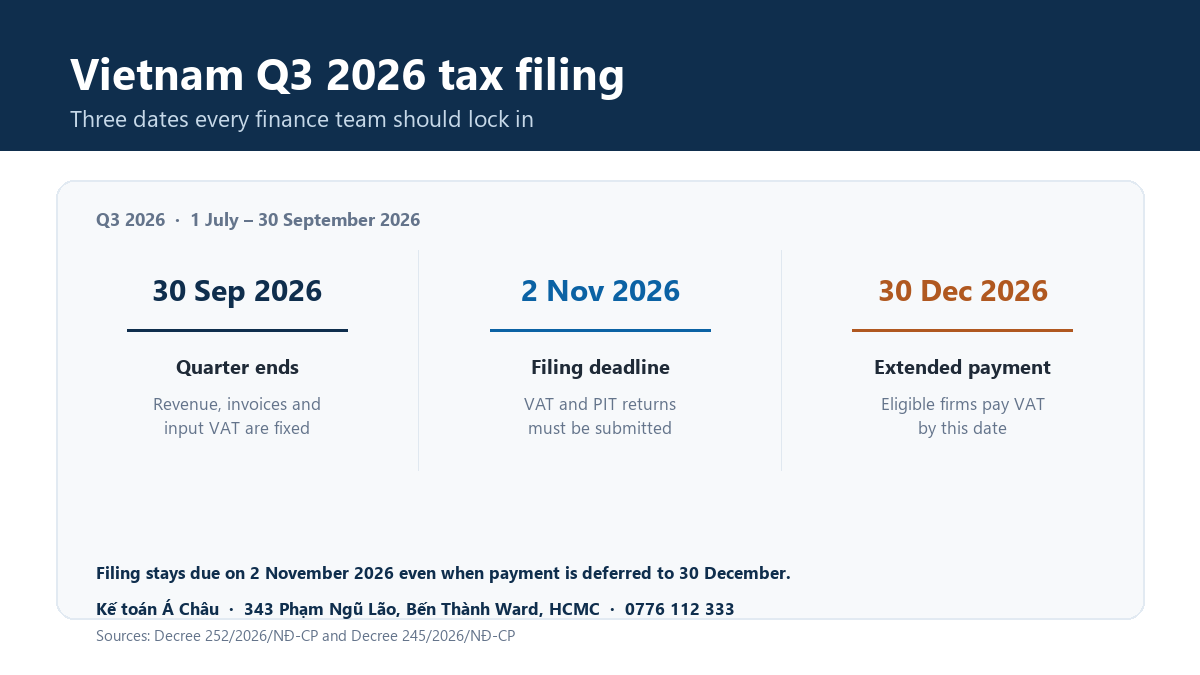
Q3 2026 tax filing in Vietnam is due on Monday, 2 November 2026. The statutory date is 31 October 2026, but it falls on a Saturday, so the deadline shifts to the next working day. Businesses that qualify under Decree 245/2026/NĐ-CP may defer payment of Q3 VAT to 30 December 2026 — the return itself is still due on 2 November.
This guide sets out the deadline, who files quarterly, and the conditions for the payment extension, citing the article and clause behind each rule.
Last reviewed: 28 October 2026. Legal basis: Decree 252/2026/NĐ-CP, Decree 245/2026/NĐ-CP and Circular 89/2026/TT-BTC.
On this page
- The Q3 2026 tax filing deadline is 2 November 2026
- Which businesses file VAT and PIT returns quarterly
- Invoices and adjustments to settle before you file
- Payment relief: deferring Q3 VAT to 30 December 2026
- Two return changes from 1 July 2026
- Five things to close before 2 November 2026
- How to submit the Q3 2026 tax filing
- Frequently asked questions
- Need help with your Q3 2026 tax filing?
- Legal basis
The Q3 2026 tax filing deadline is 2 November 2026
The Q3 2026 tax period runs from 1 July to 30 September 2026, per Article 9(2) of Decree 252/2026/NĐ-CP. Article 10 of the same decree sets the filing deadline at the last day of the first month of the following quarter — 31 October 2026.
In 2026, 31 October is a Saturday and 1 November is a Sunday. Article 3(7) of Decree 252/2026/NĐ-CP moves a deadline that lands on a non-working day to the next working day. The deadline is therefore Monday, 2 November 2026.
The table below sets out what falls due on that date.
| Obligation | Applies when | Q3 2026 deadline |
|---|---|---|
| Quarterly VAT return | The business has elected the quarterly VAT cycle | 2 November 2026 |
| Quarterly PIT withholding return | The quarter includes withheld personal income tax | 2 November 2026 |
| Payment of tax due | The business is not eligible for payment relief | 2 November 2026 |
Which businesses file VAT and PIT returns quarterly
The Q3 2026 tax filing cycle does not apply to every company. The cycle depends on prior-year revenue and on the election already registered with the tax authority.
VAT: prior-year revenue of VND 50 billion or less
Under Article 19 of Circular 89/2026/TT-BTC, a business with prior-year revenue of VND 50 billion or less may elect to file VAT quarterly. Monthly filing remains the default, and newly established businesses may also choose quarterly.
Once elected, the cycle holds for the whole calendar year. Check the registered cycle before preparing the return, because a wrong cycle creates a late-filing exposure even when the figures are correct.
PIT withholding moved to a quarterly cycle on 1 July 2026
Article 22(1)(a.1) of Circular 89/2026/TT-BTC separates the PIT withholding cycle from the VAT cycle and makes it quarterly. A company that files VAT monthly must still review its PIT obligation for the Q3 2026 tax filing.
Not every quarter requires a return. Article 11(6) of Decree 252/2026/NĐ-CP provides that an organisation or individual paying income that withholds no PIT in the quarter does not have to file a PIT return for that quarter.
Two exceptions remain: the final quarter of the year, and any quarter in which a split, merger, consolidation, dissolution, bankruptcy or cessation of activity occurs. Those returns are due even when nothing was withheld.

Invoices and adjustments to settle before you file
Most errors in a Q3 2026 tax filing come from invoices that crossed a period boundary. Two rules cover most of them.
Adjustment and replacement invoices
When an invoice from an earlier period is adjusted or replaced, first ask whether the earlier return was wrong. If it was, correct that period with a supplementary return. If the earlier return was right and the invoice simply changes later — a price adjustment, a discount, or returned goods — declare the change in the period it arises, or in the period the adjustment invoice is issued. Clause 5 Article 12 of the Law on Tax Administration 108/2025/QH15 and Article 12 of Decree 252/2026/NĐ-CP set that split.
The practical consequence: do not move every invoice dated in an earlier quarter back into that quarter. Doing so creates a mismatch between the VAT return and the e-invoice data the tax authority already holds.
Input VAT credit carried forward
A quarter with no sales still produces a return. Report the input VAT actually incurred, the credit used against output VAT, and the credit carried into the next period. Skipping the return because revenue is zero breaks the credit chain and is one of the most common reasons a credit is challenged later.
Payment relief: deferring Q3 VAT to 30 December 2026
Decree 245/2026/NĐ-CP, issued on 27 June 2026, extends payment deadlines for several taxes and for land rent during 2026. It changes one half of the Q3 2026 tax filing: payment moves, the return does not. For the third quarter, the extended date sits in Article 2(1)(d) and Article 2(2)(b).
| Amount payable | Normal deadline | Extended deadline | Conditions |
|---|---|---|---|
| Q3 2026 VAT | 2 November 2026 | 30 December 2026 | Actual business activity in an Appendix I sector, or small/micro enterprise status; tax must be payable for the period |
Import VAT is excluded from the relief under Article 2(1) of the decree.
Eligibility conditions
Article 1(2) of Decree 245/2026/NĐ-CP defines two groups. The first covers enterprises, organisations and business households whose actual production and business activity falls within a sector listed in Appendix I. The second covers small and micro enterprises under the 2017 Law on Support for Small and Medium Enterprises and Decree 80/2021/NĐ-CP.
The test is what the business actually does, not only what its registered business lines say. Compare the activity that generates revenue against Appendix I and keep supporting documents in case of review.
A business operating in several sectors qualifies for relief on the full amount if any one sector is listed in Appendix I, per Article 2(5). The remaining condition is that the period must show tax payable.
How to claim the extension
Submit the written request in the form set out in Appendix II of the decree. Article 3(2) allows a single request covering all taxes and land rent for every eligible period, filed together with the tax return.
If the request is filed separately, the cut-off is 2 November 2026. Article 3(3) states that a request submitted after that date does not qualify. Filing early is safer than filing on the last day.
Where a valid request already covers every eligible period, confirm the submission receipt is on file. If an error is found, Article 3(2) allows a replacement request.
What the relief does not cover
- It defers payment only. The filing deadline stays at 2 November 2026.
- No late-payment interest accrues during the extension period, per Article 4.
- The PIT element applies to household and individual businesses; PIT withheld from salaries is outside the relief.
Two return changes from 1 July 2026
Both changes affect the Q3 2026 tax filing directly.
- New form 01/GTGT. VAT-deducting businesses use form 01/GTGT issued with Circular 89/2026/TT-BTC for the Q3 2026 period.
- PIT withholding on a quarterly cycle. The PIT cycle is now independent of the VAT cycle, with the exception in Article 11(6) of Decree 252/2026/NĐ-CP.
Do not assume that a return on the old form will be rejected. Article 100(1) of Circular 89/2026/TT-BTC keeps the old forms for periods ending before 1 July 2026. Article 100(8) allows the forms and electronic procedures already in use to continue until the tax authority announces a uniform switch on its tax management system.
In practice, the rollout depends on upgrades to the tax-support software and the public service portal. Check the notice from your managing tax office before exporting the return. Decision 2551/QĐ-BTC of 15 September 2026 corrected Article 99(5) of Circular 89/2026/TT-BTC on the list of form templates, a narrow technical correction that does not change form 01/GTGT.
Five things to close before 2 November 2026
These five items decide whether the Q3 2026 tax filing reconciles on the first attempt.
- Lock the data period from 1 July to 30 September 2026, and keep documents dated 30 September and 1 October in the correct period.
- Reconcile declared revenue against the e-invoices issued in the quarter, including cancelled and replaced invoices.
- Review adjustment and replacement invoices. An invoice relating to an earlier period belongs in that period only where a filed return must be corrected; otherwise it is declared in the period it arises or the period the adjustment invoice is issued.
- Carry forward the input VAT credit balance from the previous period, including quarters with no revenue.
- Decide whether the business qualifies under Decree 245/2026 on actual activity, so the extension request is filed before 2 November 2026.
How to submit the Q3 2026 tax filing
The Q3 2026 tax filing is filed electronically. The mechanics matter because a return rejected by the system has not been filed, whatever the calendar says.
Channel and digital signature
Returns go through the tax authority’s electronic filing system, either as a file exported from the tax-support software or through the public service portal. Each return must carry a valid digital signature — a USB token, an HSM signature or a registered e-signature service. A return that is not signed with a valid certificate is not accepted as filed, and the deadline keeps running.
Two failure modes cause avoidable late filings: an expired or unregistered certificate discovered on the last day, and congestion on 2 November 2026 itself. Test the signature before the deadline, not on it.
Records to keep after filing
Keep the electronic submission receipt with its timestamp, the signed return file, and the working papers behind the figures: the e-invoice listing for the quarter, the reconciliation to the general ledger, and contracts or bank statements for large items. These documents are not attached to the return, but the obligation to hold them stays with the business and they are the first thing requested in a desk review.
Frequently asked questions
Is the Q3 2026 tax filing deadline 31 October or 2 November?
2 November 2026. The statutory date is 31 October, which falls on a Saturday, so Article 3(7) of Decree 252/2026/NĐ-CP moves it to the next working day.
Does the payment extension also extend the filing deadline?
No. Decree 245/2026/NĐ-CP defers payment of tax only. VAT and PIT returns for Q3 2026 remain due on 2 November 2026.
Are small businesses automatically eligible for relief?
No. Small and micro enterprises fall inside the scope of the decree, but the period must also show tax payable and the written request must reach the tax authority by 2 November 2026.
Does a company filing VAT monthly still owe a Q3 PIT return?
Only if PIT was withheld during the quarter. If nothing was withheld, Article 11(6) of Decree 252/2026/NĐ-CP removes the obligation, except for the final quarter and quarters with a split or dissolution.
Must a business with no revenue file a VAT return?
Yes, unless one of the cases in Article 11 of Decree 252/2026/NĐ-CP applies. The return still reports actual figures: input VAT, the credit available and the credit carried forward.
Can a late extension request still be accepted?
No. Article 3(3) of Decree 245/2026/NĐ-CP states that a request submitted after 2 November 2026 does not qualify for relief.
Need help with your Q3 2026 tax filing?
Kế toán Á Châu reviews your books, prepares the returns on the current forms and handles the extension request for eligible companies. See our corporate accounting and tax services, or read the checklist on deductible expenses in Vietnam.
KẾ TOÁN Á CHÂU FINANCE AND ACCOUNTING SERVICES CO., LTD
343 Phạm Ngũ Lão, Bến Thành Ward (former District 1), Ho Chi Minh City. Hotline/Zalo: 0776 112 333. Website: dichvuketoanachau.com/en/
Legal basis
- Decree 252/2026/NĐ-CP — Article 3(7), Article 9(2), Article 10, Article 11.
- Decree 245/2026/NĐ-CP — Article 1, Article 2, Article 3, Article 4.
- Circular 89/2026/TT-BTC — Article 19, Article 22, Article 100.
- Decision 2551/QĐ-BTC of 15 September 2026, correcting Article 99(5) of Circular 89/2026/TT-BTC.