


Decree 255/2026: what changed for related-party transactions in Vietnam
On 30 June 2026 Vietnam issued Decree 255/2026/ND-CP, replacing both Decree 132/2020/ND-CP and Decree 20/2025/ND-CP. It took effect on 1 July 2026 and applies from the 2026 corporate income tax period. If your Vietnamese entity transacts with a parent or affiliate abroad, the documentation you prepared under the old rules is no longer the right reference for FY2026.
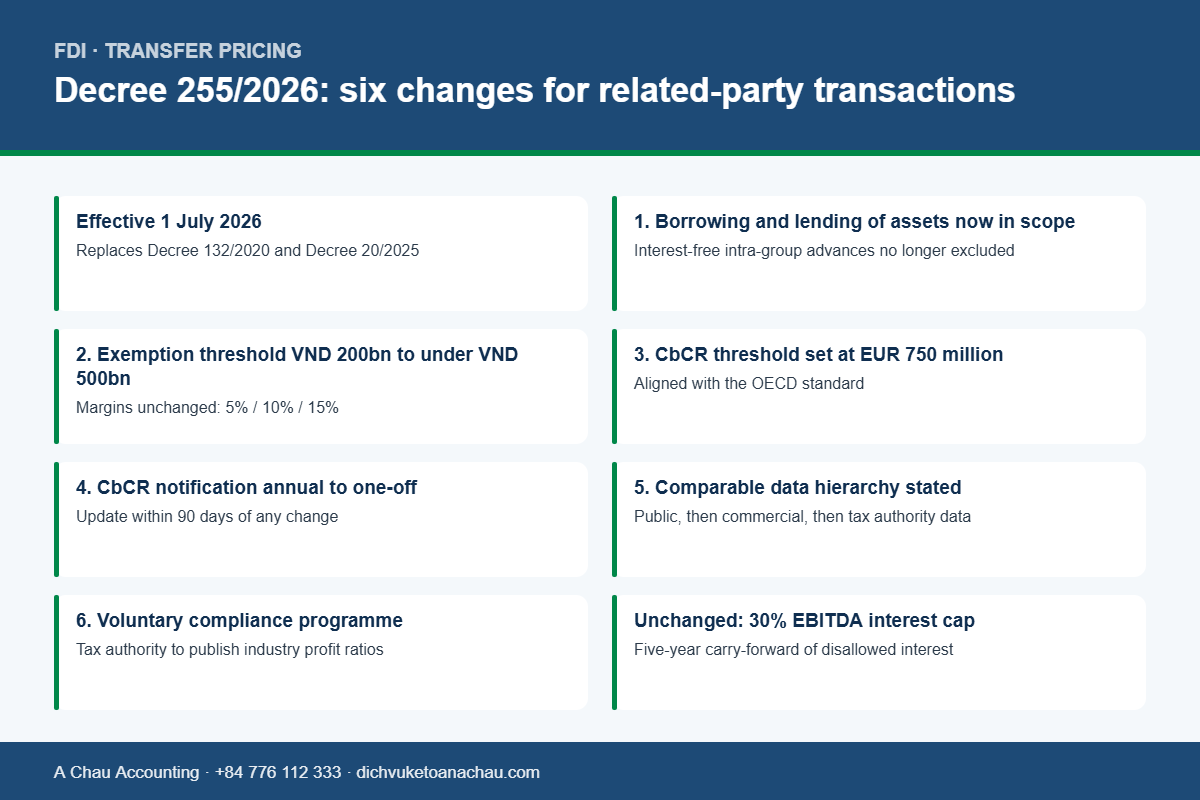
1. The six substantive changes
| # | Change | What it means in practice |
|---|---|---|
| 1 | Related-party definition now covers borrowing and lending of assets, not only loans | Interest-free intra-group cash movements no longer sit outside the definition |
| 2 | Simple-function documentation exemption threshold raised from VND 200 billion to under VND 500 billion | Mid-sized entities that previously had to prepare a full local file may now be exempt |
| 3 | CbCR threshold set at consolidated group revenue of EUR 750 million | Aligns Vietnam with the OECD standard rather than a converted VND figure |
| 4 | CbCR notification moves from annual to one-off, updated within 90 days of any change | Meaningful reduction in repeat filings for members of multinational groups |
| 5 | A stated hierarchy for comparable data: public data, then commercial databases, then tax authority data | Fewer disputes during audit about whose dataset governs |
| 6 | The tax authority is to build a voluntary compliance support programme and publish industry profit ratios | Taxpayers get a public benchmark to self-check against before an audit |
2. What did not change
3. The exemption that matters most to mid-sized FDI entities
Under the simple-function exemption an entity is relieved from preparing transfer pricing documentation — but not from filing the related-party disclosure forms — when it meets all three conditions:
| Condition | Requirement | Common failure point |
|---|---|---|
| Revenue | Under VND 500 billion in the tax period | Measured on total revenue, not only related-party revenue |
| Intangibles | No revenue or expense arising from intangible assets | Royalties, brand fees or technology fees paid to the parent break this condition |
| Profitability | Net operating profit before interest and tax over revenue of at least 5% (distribution), 10% (manufacturing), 15% (toll manufacturing) | A loss year fails the test regardless of revenue |
The practical consequence is counter-intuitive: a toll manufacturer with VND 80 billion of revenue and a 12% margin must prepare full documentation, while a distributor with VND 450 billion and a 6% margin does not. Revenue is not the deciding factor.
4. Deadlines
Thirty working days sounds generous until you consider that the benchmarking study alone — screening independent comparables, adjusting for functional differences and computing the arm’s length range — typically takes several weeks. That is exactly why the rule requires the file to exist beforehand.
5. A practical FY2026 checklist
| Step | Action | When |
|---|---|---|
| 1 | Re-map related parties against the twelve forms in Article 5, paying attention to interest-free intra-group advances | During FY2026 |
| 2 | Determine whether the entity is exempt from documentation or must prepare a full local file | Before year-end close |
| 3 | Model the 30% EBITDA interest cap against the budget to see how much interest will be disallowed | Before drawing new intra-group debt |
| 4 | Request the group master file from headquarters early — it usually lags the local timetable | Q4 |
| 5 | Complete the local file and file the disclosure appendices with the CIT return | Before the filing deadline |
Frequently asked questions
Á Châu maps related parties, prepares the Vietnamese local file, models the interest cap and files the disclosure appendices. Initial scoping is free of charge.
This article is general information current at the date of publication under Decree 255/2026/ND-CP. Application to a specific entity should be confirmed with a licensed tax practitioner against the entity’s own facts. Á Châu — 343 Pham Ngu Lao, Ben Thanh Ward, Ho Chi Minh City · Tax code 0316633224 · linhcskh@dichvuketoanachau.com
Related reading: Decree 255/2026: what changed for related-party transactions · Vietnam’s 30% EBITDA interest cap · Transfer pricing documentation service
More English guides: Accounting and tax guides for foreign companies in Vietnam — CIT, VAT, foreign contractor tax, payroll, e-invoicing and transfer pricing.
Quick answers: Twenty questions foreign finance teams ask about Vietnamese tax and accounting.
Need this handled for your company in Vietnam?
Three fields. An English-speaking adviser calls back within 4 working hours and sends a written quote within 24 hours. Bookkeeping from VND 500,000/month, priced on actual invoice volume.

