This corporate income tax Vietnam FDI guide sets out the 2026 rules under the Law on Corporate Income Tax No. 67/2025/QH15, in force since 1 October 2025 and applied from the 2025 tax year, and its guiding Decree 320/2025/ND-CP. The standard rate is 20%. Smaller companies can pay 15% or 17%, and qualifying new investment projects can pay 10% or 17% for a fixed period, with tax exemptions and reductions on top.
Tax administration for enterprises with related-party transactions is now governed by Decree 255/2026/ND-CP, effective 1 July 2026 and applicable from the 2026 tax period, which replaced the earlier transfer pricing decrees. Several thresholds have changed — see what changed under Decree 255/2026.
In short: a company incorporated in Vietnam, including a wholly foreign-owned subsidiary, pays CIT on its taxable income for each tax year. Taxable income is revenue minus deductible expenses plus other income, less exempt income and losses carried forward from up to five previous years. An expense is deductible only if it is incurred for the business, backed by lawful invoices and documents and, for each purchase or payment of VND 5 million or more, paid by non-cash means (Article 9 of Law 67/2025 and Article 9(1) of Decree 320/2025). The company pays provisional CIT each quarter and files an annual finalisation return after year-end. Incentive rates depend on the sector and location of a new investment project, not on foreign ownership. Large multinational groups should also check whether Vietnam’s global minimum tax rules apply to them.
1. Who Is Subject to CIT in Vietnam?
Enterprises established under Vietnamese law, including wholly foreign-owned companies and joint ventures, pay CIT on taxable income arising in Vietnam and on taxable income arising outside Vietnam (Article 2 of Law 67/2025). Incorporation in Vietnam is what triggers the full obligation; there is no separate residence test for a Vietnamese company.
Foreign organisations that do business in Vietnam without a local entity — contractors, service providers or digital platforms — are generally taxed through the Foreign Contractor Tax (FCT), withheld at source. See our Foreign Contractor Tax Guide.
2. CIT Rates: Standard, Small-Company and Sector Rates
The standard CIT rate in Vietnam is 20% (Article 10(1) of Law 67/2025), and it applies to most foreign-invested companies. There are no local, state or provincial income taxes — the 20% rate is the single national rate.
Certain activities carry higher rates under Article 10(4):
- Oil and gas prospecting, exploration and extraction: 25% to 50%, with the rate for each petroleum contract decided by the Prime Minister
- Exploration and extraction of rare and precious resources (such as gold, silver, gemstones and rare earths): 50%, or 40% where at least 70% of the allocated mine area lies in an extremely disadvantaged area
From the 2025 tax year, smaller companies pay lower rates based on revenue, subject to the related-party exclusion below:
| Total revenue of the preceding tax year | CIT rate | Basis |
|---|---|---|
| Up to VND 3 billion | 15% | Law 67/2025, Art. 10(2); Decree 320/2025, Art. 11(2) |
| Above VND 3 billion, up to VND 50 billion | 17% | Law 67/2025, Art. 10(3); Decree 320/2025, Art. 11(3) |
| Above VND 50 billion, or not eligible for the reduced rates | 20% | Law 67/2025, Art. 10(1) |
Watch-point for FDI subsidiaries: the 15% and 17% rates do not apply to a Vietnamese company that is a subsidiary of, or has a related-party relationship with, an enterprise that does not itself meet these revenue conditions (Article 11(4)(c) of Decree 320/2025). A small subsidiary of a large foreign group therefore usually stays at 20% unless an investment incentive applies (section 5).
3. How Taxable Income Is Calculated
The calculation follows Articles 7, 11(1) and 17 of Law 67/2025:
Assessable income = Revenue – Deductible expenses + Other income
Taxable income = Assessable income – Exempt income – Losses carried forward
CIT payable = Taxable income × CIT rate
Revenue comes from goods, services and other business activities; other income covers items such as interest, foreign exchange gains, asset disposal gains and recovered bad debts. Revenue timing follows the CIT rules, which do not always match Vietnamese Accounting Standards (VAS), so reconcile the two at year-end. A Vietnamese company may also set aside up to 20% of its annual taxable income for a science and technology development fund; if less than 70% of the fund is used within five years, or it is used for other purposes, the CIT on the unused or misused part is clawed back with interest (Article 17(2)).
Tax loss carry-forward
A tax loss can be carried forward for up to five consecutive years, starting from the year after the loss year (Article 16 of Law 67/2025). Losses cannot be carried back, and there is no group loss relief or consolidated filing among related entities in Vietnam. Keep a year-by-year loss schedule in the books — our accounting outsourcing team maintains one for each client — so every loss is used within the five-year window; an expired loss is a permanent tax cost.
Tax losses and accounting losses are not the same thing. A company can use its tax losses and still be unable to pay profit to its parent while accumulated losses remain on its balance sheet. See our guide to repatriating profits from Vietnam for the conditions that apply before profit leaves the country.
4. Deductible vs. Non-Deductible Expenses
For a detailed checklist of the conditions, the costs FDI companies most often lose at finalisation and the records to keep, see our guide to deductible expenses for CIT in Vietnam.
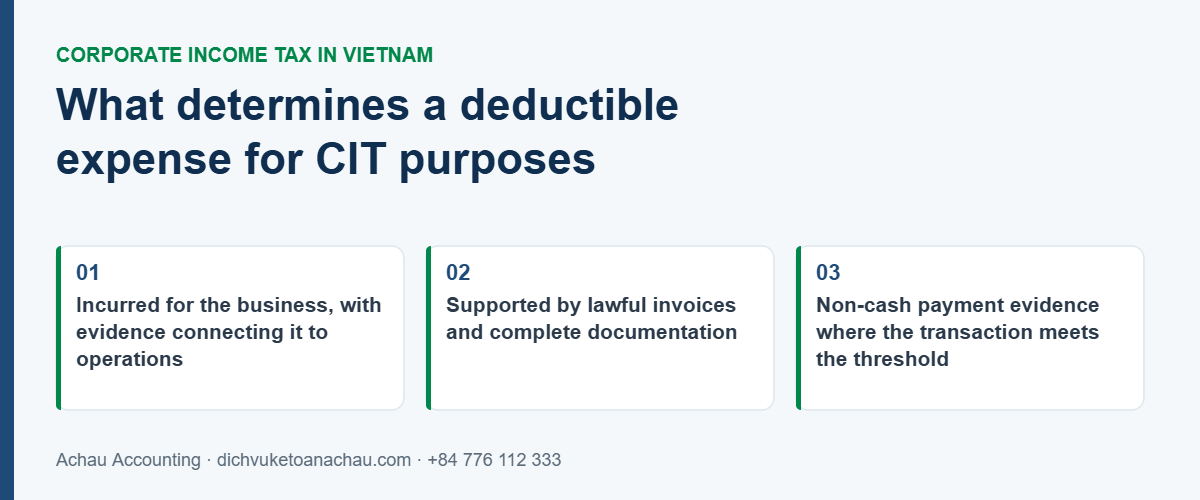
Under Article 9 of the Law on Corporate Income Tax No. 67/2025/QH15 and Article 9(1) of Decree 320/2025/ND-CP, an expense is deductible only if it is actually incurred and related to the business, and is supported by invoices and documents as required by law. Each purchase or other payment of VND 5 million or more must also be supported by non-cash payment documents, a rule that applies from 15 December 2025. Expenses listed as non-deductible in the Law and the Decree stay excluded even when these conditions are met.
Common Non-Deductible Expenses
FDI enterprises most often lose deductions on the following items (Article 10 of Decree 320/2025):
- Pay and benefits not set out in a labour contract, collective agreement or company policy (for example, bonuses or allowances without a documented entitlement)
- Purchases of VND 5 million or more without non-cash payment proof, including several same-day purchases from one seller that together reach VND 5 million
- Depreciation of assets not used for the business, without ownership papers or not recorded in the books, and the part charged outside or above the Ministry of Finance’s current depreciation regulations (Article 10(6))
- Provisions made outside the current provisioning rules for bad debts, inventory, investments and warranties
- Interest on business loans from lenders that are not credit institutions, for the part above the limit set by the Civil Code (Article 10(10))
- Fines for administrative violations and late-payment interest
- Sponsorship and donations that do not meet the conditions and documentation set by the Decree
Advertising and marketing: there is no percentage cap on advertising, marketing or promotion costs; they are deductible under the general conditions above. Only advertising for products that may not be advertised, or advertising that had to be registered but was not, is disallowed (Article 10(23) of Decree 320/2025).
A review of expense documentation before the year-end close lets you fix gaps while they can still be fixed. Our accounting review services check this documentation item by item before finalisation.
5. Tax Incentives: Eligibility, Duration and Conditions
Incentives under Law 67/2025 attach to the sector or location of a project (Article 12), not to the investor’s nationality. The main tiers are:
| Incentive | Rate | Duration | Main qualifying cases (summary) | Basis |
|---|---|---|---|---|
| Preferential rate | 10% | 15 years | New projects in high and strategic technology, software and key digital technology, semiconductor chips, AI data centres, priority supporting industries, renewable energy and key infrastructure; manufacturing projects of at least VND 12,000 billion disbursed within 5 years; new projects in extremely disadvantaged areas, high-tech parks and digital technology zones; high-tech and science and technology enterprises | Law 67/2025, Art. 12(2), 13(1) |
| Preferential rate | 17% | 10 years | New projects in high-grade steel, energy-saving products, farm machinery, animal feed, automobile manufacturing and assembly, other digital technology products and SME support facilities; new projects in disadvantaged areas or in economic zones outside incentive areas | Art. 13(4) |
| Preferential rate | 15% | No fixed period | Income from crops, planted forests, livestock, aquaculture and agricultural or aquatic processing outside incentive areas | Art. 13(3) |
| Exemption and reduction | 0%, then 50% of tax payable | Up to 4 years exempt, then up to 9 years at 50% | Income entitled to the 10% rate for 15 years | Art. 14(1) |
| Exemption and reduction | 0%, then 50% of tax payable | Up to 2 years exempt, then up to 4 years at 50% | Projects entitled to the 17% rate for 10 years | Art. 14(2) |
The preferential-rate period runs from the first year the new project has revenue. The exemption period runs from the first year with taxable income, or from the fourth year if the project has no taxable income in its first three years of revenue (Articles 13(7) and 14(4)). The Prime Minister may extend the 10% period for certain very large projects (Article 13(6)). Eligibility is tested project by project under the conditions in Decree 320/2025; for groups in scope of the global minimum tax, see section 7.
Need this handled for you? Á Châu provides tax consulting services in Vietnam for foreign-invested and Vietnamese companies — statutory filings, reporting and inspection support. Call 0776 112 333.
6. CIT Filing and Payment Cycle
Vietnam uses quarterly provisional payments and an annual finalisation return, with deadlines set by the Law on Tax Administration and its guidance. Since 1 July 2026, that law is the Law on Tax Administration No. 108/2025/QH15. Check the current tax calendar for the exact dates, especially if your fiscal year does not follow the calendar year.
Provisional payments: the quarterly payments need to keep pace with the year’s final CIT under the tax administration rules in force, so review the year’s position before the last quarterly payment rather than after the finalisation return.
7. Global Minimum Tax Impact: What FDI Enterprises Must Know
Vietnam has adopted global minimum tax rules for large multinational groups. Check first whether your group is in scope. If it is, and incentives bring a Vietnamese subsidiary’s effective tax rate below the minimum, Vietnam can collect a top-up tax itself instead of leaving it to the parent’s country, so part of the benefit of a low incentive rate is taken back. Top-up tax filings follow their own timetable, separate from the annual CIT finalisation.
Groups outside the scope keep the full benefit of CIT incentives. In-scope groups should model the effective rate after any top-up with your financial advisors at Tài Chính Á Châu or the corporate advisory team at BIZCA before choosing an investment structure.
8. Practical Action Steps for FDI Enterprises
Use this guide as a year-end checklist:
- Review your incentive eligibility: the 2025 CIT Law changed the incentive sectors and thresholds; check your project, including the transitional rules in Article 20 of Law 67/2025
- Audit expense documentation: before year-end, ensure every purchase or payment of VND 5 million or more has non-cash payment proof, all labour costs are backed by contracts or policies, and depreciation follows the current Ministry of Finance rules
- Model your global minimum tax exposure: if your group may be in scope, work with a financial advisory team and business restructuring advisors to quantify the top-up tax impact
- Track loss carry-forwards: maintain a five-year loss schedule and monitor expiry dates — an expired loss is a permanent tax cost
- Keep provisional payments on track: review the year’s estimated CIT before the last quarterly payment
- Stay current with Decree 255/2026 compliance: if your enterprise has related-party transactions, prepare transfer pricing documentation contemporaneously, not reactively during an audit
Service fees
Bookkeeping and tax filing packages start from VND 500,000/month; the fee depends on invoice volume, payroll size and reporting needs, through our accounting outsourcing services in Vietnam. CIT finalisation, incentive reviews and transfer pricing files are quoted after we review your records, through our corporate tax finalisation service and tax consulting service. All work is VAS-compliant and delivered in English. Call 0776 112 333 (+84 776 112 333), email info@dichvuketoanachau.com, or use the form below.
Need this handled for your company in Vietnam?
Three fields. An English-speaking adviser calls back within 4 working hours and sends a written quote within 24 hours. Bookkeeping from VND 500,000/month, priced on actual invoice volume.
Frequently Asked Questions
What is the standard CIT rate in Vietnam for FDI enterprises?
The standard rate is 20% (Article 10 of Law 67/2025), and it applies to most foreign-invested companies. Companies whose total revenue in the preceding tax year was up to VND 3 billion pay 15%, and those above VND 3 billion up to VND 50 billion pay 17%, but a subsidiary or related party of a larger enterprise cannot use these rates.
Can an expense paid in cash still be deducted?
For any purchase or other payment of VND 5 million or more per transaction, the expense is deductible only with non-cash payment documents (Article 9(1)(c) of Decree 320/2025/ND-CP, applied from 15 December 2025). Several purchases from the same seller on the same day are added together. A purchase of VND 5 million or more that is unpaid when the expense is recorded may be deducted; if any part is later paid without non-cash proof, reduce expenses by that part in the period of payment, even if a tax inspection or audit decision already covers the period in which the expense was recorded (Article 9(1)(c3)).
What expenses are not deductible for CIT in Vietnam?
Article 10 of Decree 320/2025 sets out the list. The items FDI companies hit most are pay not set out in a contract or policy, purchases of VND 5 million or more without non-cash proof, depreciation outside the Ministry of Finance’s rules, provisions outside the provisioning rules, interest on loans from lenders that are not credit institutions above the Civil Code limit, and fines.
How long can tax losses be carried forward in Vietnam?
Up to five consecutive years, starting from the year after the loss year (Article 16 of Law 67/2025). There is no loss carry-back and no group loss relief or consolidated filing, so a loss not used within five years is lost for good. Tax losses are separate from accumulated accounting losses, which can still block profit remittance to the parent.
How does the global minimum tax affect FDI enterprises in Vietnam?
Vietnam has adopted global minimum tax rules for large multinational groups, so first check whether your group is in scope. If it is, and incentives bring a Vietnamese subsidiary’s effective tax rate below the minimum, Vietnam can collect a top-up tax, which reduces the value of those incentives. Groups outside the scope keep the full benefit.
Official sources: Vietnam Laws (VBPL) · Thu Vien Phap Luat · Ministry of Finance Portal
Related Guides:
- Repatriating profits from Vietnam: conditions and checklist
- Foreign contractor tax in Vietnam
- FDI audit readiness checklist
- Vietnam Accounting Standards (VAS) & bookkeeping
- Accounting and bookkeeping services in Vietnam
- Tax consulting services in Vietnam
- Closing a company in Vietnam: tax clearance process
Related services:
- Full-service accounting in Vietnam
- Corporate tax finalization service
- Tax consulting
- FDI and transfer pricing tax advisory
- Tax risk management advisory
Achau Accounting · 343 Pham Ngu Lao, Ben Thanh Ward, Ho Chi Minh City · +84 776 112 333 · linhcskh@dichvuketoanachau.com
Related reading: What changed under Decree 255/2026 · The 30% EBITDA interest cap · Transfer pricing documentation service
More English guides: Accounting and tax guides for foreign companies in Vietnam — CIT, VAT, foreign contractor tax, payroll, e-invoicing and transfer pricing.
Á Châu khảo sát hồ sơ thực tế rồi tư vấn theo đúng tình hình của doanh nghiệp, không tư vấn theo quy định chung. Khảo sát sơ bộ không tính phí.
Gọi 0776 112 333Gửi yêu cầu tư vấn
Tra cứu nhanh: 30 câu hỏi thường gặp · Cẩm nang kế toán và thuế · Thư viện văn bản pháp luật