


Updated 17 October 2026 · General information, not accounting or tax advice for a specific company.
Vietnam accounting standards vs IFRS is a question every foreign-invested company meets at least twice a year: when the parent asks for its group reporting package, and when the audited local statements show a different profit. The two frameworks share a common root, but they treat leases, revenue, credit losses and asset values differently. This guide sets out the practical differences and how to run both without doubling the work.
For the bookkeeping rules themselves, see our guide to Vietnam Accounting Standards and bookkeeping requirements; for the annual audit cycle, see the FDI audit readiness checklist.
Can an FDI company in Vietnam report under IFRS instead of VAS?
By default, no: the statutory financial statements filed in Vietnam are prepared under Vietnamese Accounting Standards (VAS) and the applicable accounting regime. For enterprises that previously applied Circular 200/2014/TT-BTC, that regime is Circular 99/2025/TT-BTC for financial years beginning on or after 1 January 2026; small and medium-sized enterprises may follow the separate SME accounting regime instead. The Ministry of Finance runs an IFRS roadmap under which some companies may apply IFRS if they meet its conditions; whether that option is open to your company depends on the Ministry’s current guidance. In practice, a subsidiary keeps its legal books under VAS, has its VAS statements audited under current regulations, and calculates corporate income tax from them. IFRS figures are produced as a separate layer for the parent’s consolidation: the VAS trial balance mapped to the group chart of accounts, plus a set of documented adjustments. The aim is one ledger and one reconciliation, not two parallel bookkeeping systems.
Vietnamese is the written language of accounting, and financial statements that use a foreign language must show Vietnamese alongside it (Law on Accounting No. 88/2015/QH13, Article 11(1), as amended by Law No. 56/2024/QH15). A bilingual chart of accounts also makes the group mapping easier to audit.
Vietnam accounting standards vs IFRS: the differences that matter
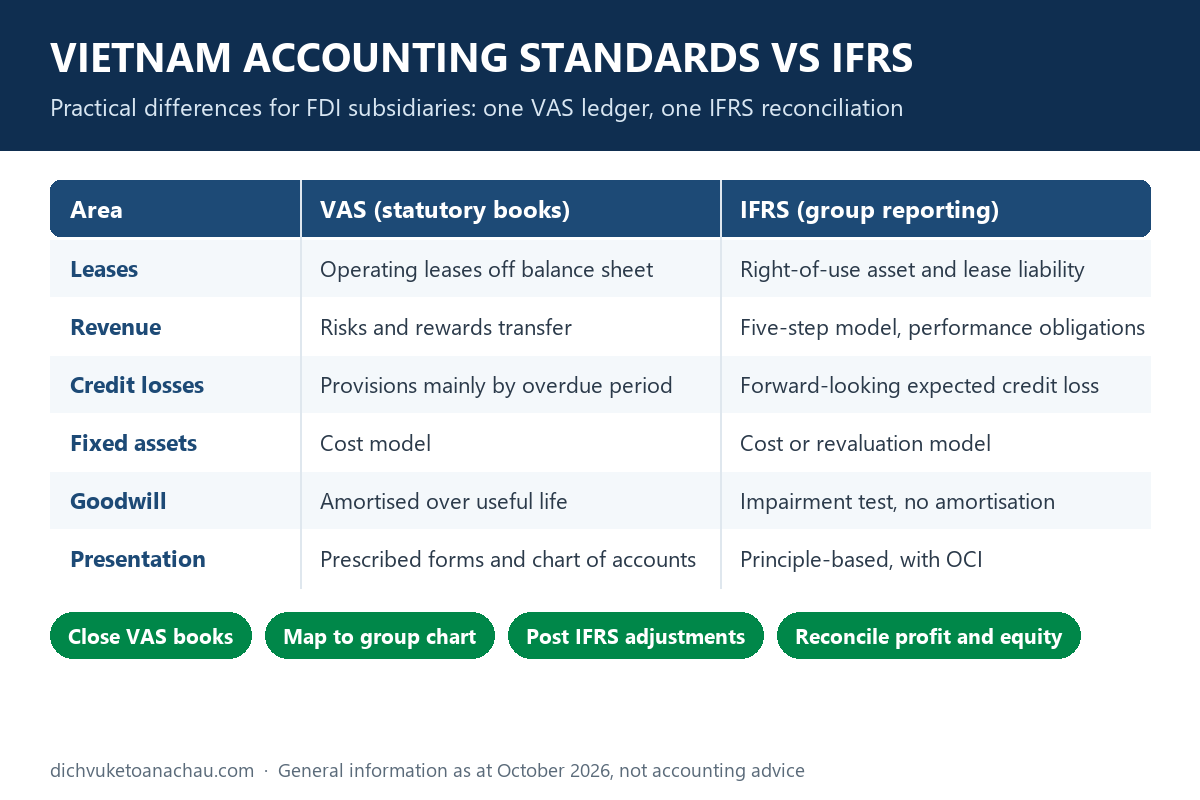
The table compares Vietnam accounting standards vs IFRS in the areas that most often change the numbers in a reconciliation for an FDI subsidiary. It reflects VAS and the enterprise accounting regime as at October 2026.
| Area | VAS (statutory books in Vietnam) | IFRS (group reporting) | Practical effect |
|---|---|---|---|
| Leases (lessee) | Operating leases expensed on a straight-line basis and kept off the balance sheet; finance leases capitalised (VAS 06) | Most leases recognised as a right-of-use asset and a lease liability, with exemptions for short-term and low-value leases (IFRS 16) | Leases add assets and debt; rent becomes depreciation plus interest |
| Revenue | Recognised when risks and rewards transfer, with separate rules for construction contracts (VAS 14, VAS 15) | Five-step model built on performance obligations (IFRS 15) | Bundled sales and rebates may shift revenue between periods |
| Receivables and credit losses | Doubtful-debt provisions under Ministry of Finance rules, driven mainly by how long a debt is overdue | Forward-looking expected credit loss model (IFRS 9) | IFRS often needs an allowance earlier, including on debts not yet overdue |
| Property, plant and equipment | Cost model (revaluation only where required by the State); VAS 03 also requires periodic review of useful lives, but in practice lives follow the Ministry of Finance depreciation framework | Cost or revaluation model; useful lives and residual values reviewed each year; significant components depreciated separately (IAS 16) | Carrying values drift apart over time |
| Impairment of non-financial assets | No general impairment standard equivalent to IAS 36 | Impairment test when indicators exist, and every year for goodwill (IAS 36) | Write-downs may appear only in the IFRS figures |
| Goodwill | Amortised over its useful life (VAS 11) | Not amortised; tested for impairment (IFRS 3, IAS 36) | Profit differs every year after an acquisition |
| Foreign currency | Accounting currency rules in the Law on Accounting; year-end revaluation of monetary items under Ministry of Finance guidance (VAS 10) | Functional currency set by the primary economic environment; closing rates (IAS 21) | Small rate differences create intercompany mismatches |
| Presentation | Prescribed statement forms and chart of accounts; no other comprehensive income | Principle-based presentation, including other comprehensive income (IAS 1) | Mapping and reclassification needed for every reporting package |
Where the numbers move most in an FDI subsidiary
In a typical manufacturing, trading or service subsidiary, five adjustments do most of the work when comparing VAS and IFRS figures.
1. Leases
A company renting its factory, warehouse, land or offices shows the rent as an operating expense under VAS. Under IFRS 16 the same contract creates a right-of-use asset and a lease liability, and the expense becomes depreciation plus interest, heavier in the early years. EBITDA and reported debt both rise. Keep a lease register with terms, payments and discount rates so the adjustment rolls forward monthly.
2. Revenue timing
Under VAS, revenue on a sale of goods is recognised when the risks and rewards pass and the amount can be measured reliably. IFRS 15 asks what the distinct promises in the contract are and when each is satisfied. Differences appear with installation bundled into equipment sales, volume rebates and milestone contracts; keep a contract log for anything non-standard.
3. Credit losses
VAS provisions for doubtful debts follow Ministry of Finance rules that look mainly at how long a receivable is overdue and at evidence such as a debtor’s insolvency. IFRS 9 requires an expected credit loss allowance from the start, usually through a provision matrix based on payment history adjusted for current conditions. The IFRS top-up does not change how provisions are treated for local tax.
4. Fixed assets and depreciation
VAS 03 also requires useful lives to be reviewed periodically, but in practice local books depreciate assets over periods set by the Ministry of Finance depreciation framework, partly so that book depreciation matches what is deductible, and revaluation is allowed only where the State requires it. IFRS uses management’s own estimate of useful life and residual value, reviewed at least at each year end, permits a revaluation model as a policy choice, and requires separate depreciation of significant components.
5. Deferred tax and exchange rates
VAS 17 covers deferred tax with concepts close to IAS 12, but local books often leave deferred tax unrecorded or incomplete, and each IFRS adjustment above has its own deferred tax effect. If the subsidiary and the parent revalue an intercompany balance at different rates, the elimination fails, so agree the rate source in the group manual.
What is broadly the same under VAS and IFRS?
VAS was built largely from the international standards of its time, so several areas usually need little or no adjustment:
- Inventories at the lower of cost and net realisable value (VAS 02, IAS 2).
- Borrowing costs capitalised on qualifying assets (VAS 16, IAS 23).
- Provisions for present obligations such as warranties (VAS 18, IAS 37).
- Related-party disclosures (VAS 26, IAS 24); transfer pricing is a separate tax obligation, covered in our guide to related-party transactions under Decree 255/2026.
How do you run VAS books and IFRS group reporting together?
The efficient way to handle VAS and IFRS reporting is a single legal ledger under VAS with the IFRS figures built on top of it. A workable monthly routine looks like this:
- Close the VAS books: bank, VAT, payroll, accruals and intercompany confirmations.
- Map the VAS chart of accounts to the group chart in a maintained mapping table.
- Post IFRS adjustments in a separate layer: leases, expected credit losses, revenue timing, depreciation differences and deferred tax.
- Reconcile profit and equity from VAS to IFRS every reporting period, with each adjustment referenced to a working paper.
- Agree intercompany balances and rates with the parent before submission.
- Carry the reconciliation into the year end, so the statutory auditor and the group auditor work from the same figures.
Who usually owns each step when bookkeeping is outsourced:
| Step | Usual owner | Output |
|---|---|---|
| VAS bookkeeping and monthly close | Local accounting team or outsourced provider | VAS trial balance and tax returns |
| IFRS adjustments | Local team, reviewed by group finance | Adjustment schedule with working papers |
| VAS statutory financial statements | Local team; signed by the preparer, the chief accountant and the legal representative | Statements for audit and filing |
| Statutory audit | Independent audit firm | Audit report on the VAS statements |
| Group reporting package | Local team, reviewed by group finance and the group auditor | IFRS package and VAS-to-IFRS reconciliation |
Common mistakes in VAS-to-IFRS conversion
- Changing the statutory ledger to IFRS figures. The legal books and the tax returns stay on VAS; keep IFRS in a separate layer.
- Rebuilding the reconciliation every year end instead of rolling it forward monthly.
- Using different exchange rates for intercompany balances on each side, so eliminations fail.
A periodic bookkeeping review catches most of these before the auditors do.
How VAS vs IFRS affects tax, audit and profit remittance
Corporate income tax is calculated from the statutory VAS accounts, adjusted under the Law on Corporate Income Tax No. 67/2025/QH15; IFRS adjustments made for the parent do not by themselves change the tax payable. Expenses still have to meet the conditions explained in our guide to deductible expenses for CIT in Vietnam, and the wider regime is covered in our corporate income tax guide for FDI companies.
The statutory audit of a foreign-invested company, required under current regulations, is performed on the VAS statements by an independent audit firm. Profit available to send to the parent is read from the audited VAS statements after the CIT finalisation, as explained in our guide to repatriating profits from Vietnam. Achau Accounting is an accounting services company, not an audit firm: we keep the VAS books, prepare the statements and the reconciliation, and help answer the auditors’ questions.
Service fees
Accounting packages start from VND 500,000/month; the fee depends on invoice volume, payroll size and reporting needs, through our accounting outsourcing services in Vietnam. A VAS-to-IFRS reconciliation, a group reporting package or year-end support for the statutory audit is quoted after we review your books and the parent’s reporting requirements. Year-end tax work runs through our corporate tax finalisation service; in-house teams can use accounting staff outsourcing. Call 0776 112 333 or use the form below.
Does your parent need IFRS figures from your Vietnamese books?
Leave your details and an adviser will contact you and send a written quote.
Frequently asked questions
Do we need to keep two sets of books for VAS and IFRS?
No. Keep one legal ledger under VAS and produce the IFRS figures as a mapped trial balance plus documented adjustments. The statutory statements, tax returns and audit stay on VAS.
Can our accounting currency be US dollars instead of VND?
The Law on Accounting allows a company whose receipts and payments are mainly in a foreign currency to choose that currency for its accounting, subject to the conditions in the Law and Ministry of Finance rules, and financial statements used in Vietnam must still be converted into VND under current regulations. The standards applied are still VAS.
Which Vietnam accounting standards vs IFRS differences cause the largest adjustments?
For most FDI subsidiaries: leases under IFRS 16, expected credit losses under IFRS 9, revenue timing under IFRS 15, depreciation differences, and the deferred tax on all of them. Goodwill and investment property matter only for groups that hold them.
Did Circular 99/2025/TT-BTC bring VAS in line with IFRS?
Circular 99/2025/TT-BTC replaced Circular 200/2014/TT-BTC as the enterprise accounting regime for financial years beginning on or after 1 January 2026; small and medium-sized enterprises may follow the separate SME accounting regime instead. It sets the chart of accounts, books and statement forms used with VAS. Applying IFRS remains a separate question under the Ministry of Finance’s IFRS roadmap, so check the Ministry’s current guidance before relying on any change.
Can an outsourced accountant prepare the IFRS reconciliation for our parent?
Yes. The team that keeps the VAS books is usually best placed to prepare the mapping, adjustment schedules and reconciliation, which group finance then reviews. Agree judgements such as lease discount rates with the parent and its auditor. The statutory audit itself must be done by an independent audit firm, not by your accounting provider.
Related services: Tax consulting in Vietnam · FDI and transfer pricing tax advisory
Related Guides: Vietnam Accounting Standards and bookkeeping · FDI audit readiness checklist · Choosing an accounting firm in Vietnam
More English guides: Accounting and tax guides for foreign companies in Vietnam
Achau Accounting · 343 Pham Ngu Lao, Ben Thanh Ward (former District 1), Ho Chi Minh City · +84 776 112 333 · linhcskh@dichvuketoanachau.com

