


Vietnam’s 30% EBITDA interest cap: how it works under Decree 255/2026
For a foreign-invested company funded largely by intra-group debt, this single rule usually costs more than every other transfer pricing obligation combined. Interest is real, paid and documented — and a portion of it is still disallowed for corporate income tax. This article sets out the formula, works a numeric example, and explains the carry-forward mechanism most finance teams discover too late.
1. The rule
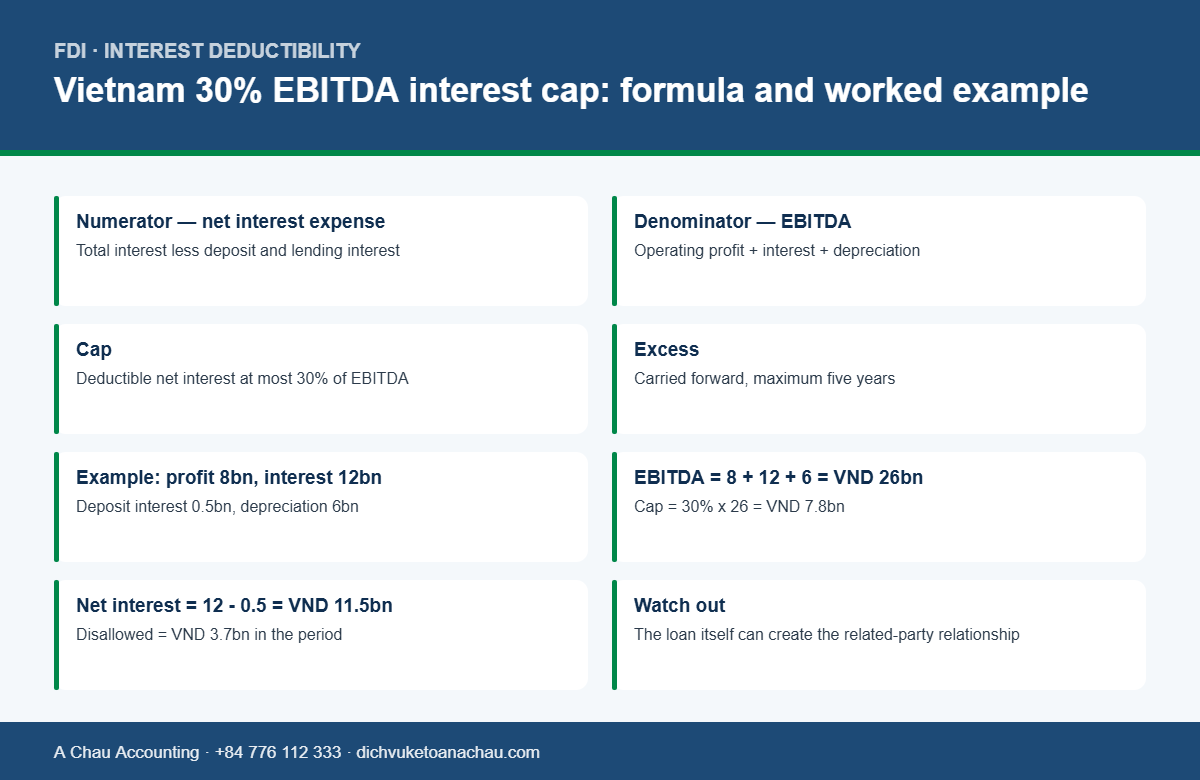
Under Article 16(3) of Decree 255/2026/ND-CP, total interest expense in the period — net of deposit interest and lending interest — is deductible only up to 30% of operating profit plus interest expense plus depreciation and amortisation for that tax period. The disallowed excess may be carried forward to subsequent tax periods for up to five years.
| Element | Definition |
|---|---|
| Numerator — net interest expense | Total interest expense incurred in the period less deposit interest and lending interest |
| Denominator — EBITDA | Net operating profit plus interest expense plus depreciation and amortisation |
| Cap | Deductible net interest ≤ 30% × EBITDA |
| Excess | Carried forward, maximum five years |
Two points are frequently misread. First, the cap applies to all interest expense of an in-scope entity, not only interest on related-party debt. Second, the entity is in scope because it has related-party relationships and transactions in the period — the cap is not switched on by the size of the loan.
2. Worked example
Assume for one tax period: net operating profit VND 8 billion, interest expense VND 12 billion, deposit interest VND 0.5 billion, depreciation VND 6 billion.
| Step | Computation | Result |
|---|---|---|
| Net interest expense | 12 − 0.5 | VND 11.5 billion |
| EBITDA | 8 + 12 + 6 | VND 26 billion |
| Deductible cap | 30% × 26 | VND 7.8 billion |
| Disallowed in the period | 11.5 − 7.8 | VND 3.7 billion |
That VND 3.7 billion increases taxable income for the period. It is carried forward — but only usable in a later period that has headroom below its own 30% cap. A highly geared entity rarely has that headroom, so in practice the carry-forward often expires unused after five years.
3. Three variables that decide whether you breach the cap
4. What to do before drawing new intra-group debt
| # | Action | Why it matters |
|---|---|---|
| 1 | Model the cap against the full-year budget, not the current run rate | Turns the disallowance into a known cost of capital rather than a year-end surprise |
| 2 | Compare debt funding with an equity injection | Equity creates no interest expense and therefore no disallowance, at the cost of flexibility on repatriation |
| 3 | Check whether the loan itself creates a related-party relationship | A loan or guarantee reaching 25% of the borrower’s owner capital and exceeding 50% of its medium and long-term debt establishes the relationship on its own |
| 4 | Consider drawdown timing within the year | Interest accrues over time; a late drawdown produces a smaller interest charge in that period |
| 5 | Open a schedule tracking disallowed interest by year of origin | The five-year limit runs per originating year; a single pooled figure cannot be aged correctly |
5. How this connects to the rest of the regime
An entity subject to the interest cap is by definition an entity with related-party transactions, which means it also has disclosure obligations and, unless exempt, must prepare transfer pricing documentation before the corporate income tax finalisation filing. See what changed under Decree 255/2026 for the full picture, and the three documentation tiers and their deadlines.
Interest is only one of the expense lines tested at finalisation; for the others, see our guide to deductible expenses for CIT in Vietnam.
Frequently asked questions
Á Châu models the interest cap against your budget, quantifies the disallowance and maintains the carry-forward schedule by year of origin. Initial scoping is free of charge.
This article is general information current at the date of publication under Decree 255/2026/ND-CP. The numeric example illustrates the formula only and is not the data of any actual entity. Application to a specific entity should be confirmed with a licensed tax practitioner. Á Châu — 343 Pham Ngu Lao, Ben Thanh Ward, Ho Chi Minh City · Tax code 0316633224
More English guides: Accounting and tax guides for foreign companies in Vietnam — CIT, VAT, foreign contractor tax, payroll, e-invoicing and transfer pricing.
Quick answers: Twenty questions foreign finance teams ask about Vietnamese tax and accounting.
Need this handled for your company in Vietnam?
Three fields. An English-speaking adviser calls back within 4 working hours and sends a written quote within 24 hours. Bookkeeping from VND 500,000/month, priced on actual invoice volume.

