Vietnam accounting and tax: questions foreign finance teams ask
Twenty questions answered against the regulation actually in force, with the decree or circular named in each answer. Updated for the 2026 changes: Decree 255/2026 on related-party transactions, Circular 99/2025 on the enterprise accounting regime, and Resolution 110/2025 on personal deductions.
20questions
6topics
2026current regulation
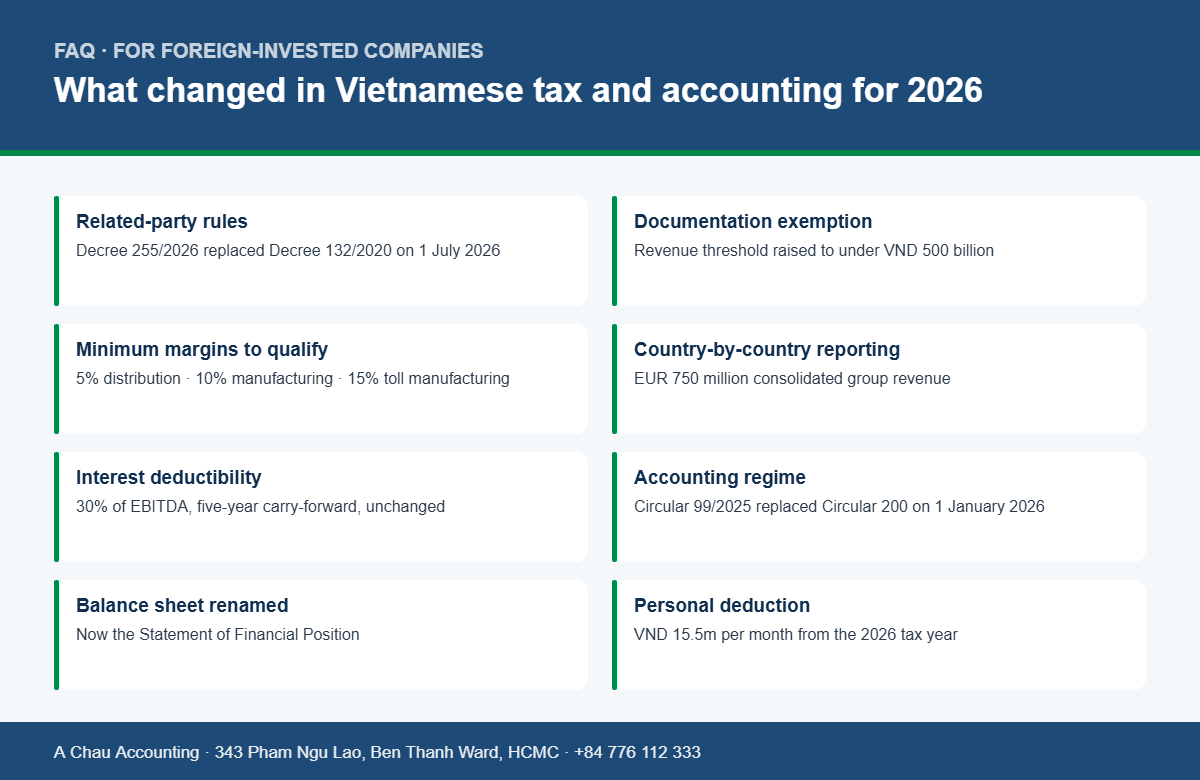
Summary of the 2026 changes to Vietnamese tax and accounting rules that foreign finance teams ask about
Related-party transactions and transfer pricing
Which decree governs related-party transactions in Vietnam in 2026?Decree 255/2026/ND-CP, issued on 30 June 2026 and effective from 1 July 2026. It applies from the 2026 corporate income tax period and replaces both Decree 132/2020/ND-CP and Decree 20/2025/ND-CP. Guidance still citing Decree 132 as current is out of date.
When do two companies count as related parties?Article 5 of Decree 255/2026 lists twelve forms across three groups: capital, management and control, and other links. The most common triggers are direct or indirect ownership of 25% or more of owner capital, and the right to appoint more than half of the management body.
Are interest-free intra-group advances in scope?Very likely yes. Decree 255/2026 extended the related-party definition to cover borrowing and lending of assets, not only loans. The absence of interest no longer places the arrangement outside the definition, and the arrangement itself can create the relationship.
Who is exempt from preparing transfer pricing documentation?Three cases: revenue under VND 50 billion with related-party transactions under VND 30 billion; an advance pricing agreement in place with annual compliance reports; or revenue under VND 500 billion with no intangible-related revenue or expense and a minimum net operating margin for the entity function.
What are the minimum profit margins for the simple-function exemption?Net operating profit before interest and tax over revenue of at least 5% for distribution, 10% for manufacturing and 15% for toll manufacturing. A loss-making year fails the test regardless of revenue.
Does a documentation exemption also remove the filing obligation?No, and this is the most common misreading. Unless the entity transacts only with Vietnamese corporate income tax payers at the same rate with no party enjoying an incentive, the related-party disclosure appendices are still filed with the corporate income tax finalisation return.
How does the interest deductibility cap work?Article 16(3) of Decree 255/2026 caps net interest expense, after deducting deposit and lending interest, at 30% of operating profit plus interest expense plus depreciation. Disallowed interest carries forward for up to five years.
Does the interest cap apply to bank debt as well as shareholder loans?Yes. The computation takes total interest expense of the period without distinguishing lender type. What brings an entity into scope is having related-party relationships and transactions in the period, not the identity of the lender.
When must transfer pricing documentation exist?It must be complete before the corporate income tax finalisation return is filed and retained ready for inspection. It is not submitted with the return. On request, it must be provided within 30 working days, extendable once by up to 15 working days for a justified reason.
What is the country-by-country reporting threshold?Consolidated group revenue of EUR 750 million or more, applying from 1 July 2026 under Decree 255/2026. Notification also moved from an annual filing to a one-off filing when the obligation first arises, updated within 90 days of any change.
Accounting regime and financial statements
Which accounting regime applies to Vietnamese entities in 2026?Circular 99/2025/TT-BTC, effective 1 January 2026, applying to financial years beginning on or after that date. It replaces Circular 200/2014/TT-BTC and three related circulars and covers enterprises in all sectors and ownership forms.
What changed under the new accounting circular?The balance sheet is renamed the Statement of Financial Position; twelve accounts were added and twenty-nine removed; the list of ledger templates is now 42; and enterprises may adjust the chart of accounts themselves without Ministry of Finance approval, provided they issue an internal account-opening regulation and accept responsibility for it.
Which regime applies to FY2025 financial statements?Circular 200/2014/TT-BTC and its amendments. Circular 99/2025 applies only to financial years beginning on or after 1 January 2026, so FY2025 statements filed during 2026 still follow the previous regime.
Payroll and personal income tax
What is the personal deduction for Vietnamese personal income tax in 2026?VND 15.5 million per month for the taxpayer, equal to VND 186 million per year, and VND 6.2 million per month for each dependant, under Resolution 110/2025/UBTVQH15 and applying from the 2026 tax year. The 2025 finalisation still uses the previous VND 11 million and VND 4.4 million.
Tax administration
What is the late-payment interest rate on Vietnamese tax?0.03% per day on the outstanding tax, roughly 10.95% per year, under Article 59 of the Law on Tax Administration 38/2019/QH14. It runs from the original due date, not from the date the tax authority raises the issue.
Acquiring a Vietnamese company
Does a buyer inherit the target company’s tax liabilities?In substance, yes. Tax obligations attach to the legal entity, not to the holder of the capital, so a change of owner does not extinguish liabilities already incurred. The only protection is warranties, indemnities or a holdback agreed before signing.
What extra step applies when a foreign investor acquires a Vietnamese company?Registration of the capital contribution or share purchase under Article 26 of the Law on Investment 61/2020/QH14, before the member or shareholder change is filed. It applies where the investor will hold more than 50% of charter capital, among other cases, and takes 15 working days from a complete file.
How long does an acquisition of a Vietnamese company take?Typically two to four months where the target’s records are complete, and four to eight months where books must be reconstructed or tax exposures resolved before signing. Record quality, not revenue size, drives the timeline.
Administrative reorganisation in Ho Chi Minh City
Has Ho Chi Minh City abolished its districts?Yes. From 1 July 2025 the city runs a two-tier administration with no district level, leaving 168 commune-level units: 113 wards, 54 communes and one special zone.
Must a company update its registered address after the ward mergers?No. The tax authority updated address records itself, and invoices showing either the former or the new administrative unit remain valid, because the address on an invoice is the seller’s registered business address.
Read further
All English guidesCIT, VAT, foreign contractor tax, payroll, e-invoicing, audit readiness
Leave your details below and we will come back to you during working hours, Monday to Friday, 08:00 to 17:30 Vietnam time. Initial scoping is free of charge and we work in English and Vietnamese.
General information current at the date of publication. Application to a specific entity should be confirmed with a licensed practitioner against that entity’s own facts. Á Châu — Công ty TNHH Dịch vụ Tài chính – Kế Toán Á Châu · Tax code 0316633224 · 343 Pham Ngu Lao, Ben Thanh Ward, Ho Chi Minh City.