


Updated 28 September 2026 · General information, not legal or tax advice for a specific company.
Closing a company in Vietnam is not one filing but a sequence. The owners resolve to dissolve, the authorities and employees are notified, every tax obligation is settled and the tax code is terminated, and only then does the business registration authority record the company as dissolved. A foreign-invested company has one more layer: the investment project behind its Investment Registration Certificate must be terminated as well.
This guide covers limited liability and joint stock companies, with notes for foreign-invested enterprises (FDI), and relies on the Law on Enterprises No. 59/2020/QH14 (Luật Doanh nghiệp, as amended, including by Law No. 76/2025/QH15), the Law on Investment No. 143/2025/QH15, in force since 1 March 2026 (replacing Law No. 61/2020/QH14), and the Law on Tax Administration No. 108/2025/QH15, in force since 1 July 2026 in place of Law No. 38/2019/QH14. Deadlines set by decrees we have not re-checked are described as “under current regulations”.
Closing a company in Vietnam: the short answer
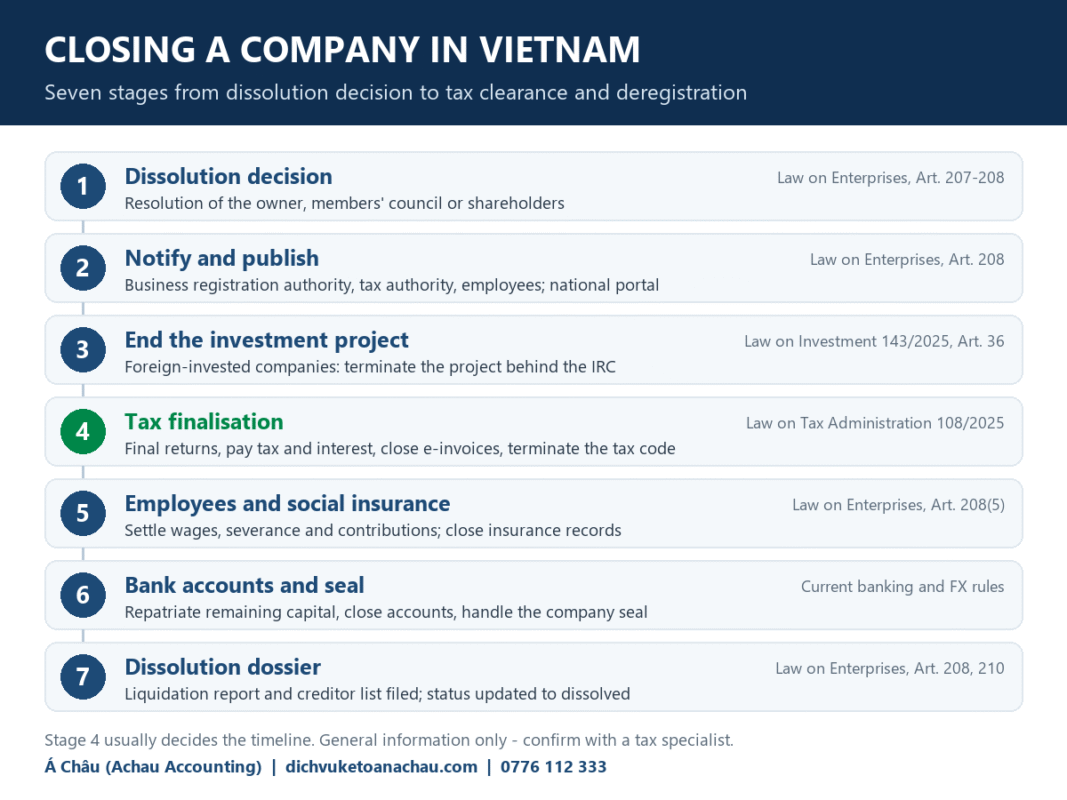
To close a company in Vietnam by voluntary dissolution, the owner, members’ council or general meeting of shareholders passes a dissolution resolution under Article 208 of the Law on Enterprises. Within seven working days, the resolution and meeting minutes go to the business registration authority, the tax authority and employees, and the resolution is published on the National Business Registration Portal. The company then stops normal trading, collects receivables, sells assets and pays debts in the statutory order: employee wages, severance and insurance first, tax second, other creditors last. In parallel, it files final tax returns, pays outstanding tax and late-payment interest, closes its e-invoices and has its tax identification number terminated. A foreign-invested company also terminates its investment project under Article 36(1) of the Law on Investment No. 143/2025/QH15. Within five working days after all debts are paid, the legal representative files the dissolution dossier and the authority updates the company’s legal status. In practice, tax clearance is the stage that decides how long the whole process takes.
One precondition: under Article 207(2), a company may be dissolved only if it can pay all debts and property obligations and is not in a dispute before a court or arbitration body. Otherwise, dissolution is the wrong route.
Dissolution, bankruptcy or suspension: which route fits?
Vietnamese law separates several routes, and choosing the wrong one can cost months.
| Route | When it fits | Who drives it | Legal basis | Tax code |
|---|---|---|---|---|
| Voluntary dissolution | Solvent, no pending court or arbitration dispute | Owner, members’ council or shareholders | Law on Enterprises, Articles 207, 208 and 210 | Terminated after tax clearance |
| Compulsory dissolution | Registration certificate revoked, or a court decision | The authority or court; debts must still be settled | Law on Enterprises, Article 209 | Terminated once obligations are settled |
| Bankruptcy | Cannot pay its debts | Court-supervised proceedings | Law on recovery and bankruptcy; Law on Tax Administration 108/2025, Article 17(1)(b) | Handled in the proceedings |
| Temporary suspension | A pause; the entity is kept | Company notifies the registration authority at least three working days ahead | Law on Enterprises, Article 206 | Stays active; debts still payable |
| Walking away | Never a legal route | — | Law on Tax Administration 108/2025, Article 17(1)(c) and 17(5) | Owner or contributing members and shareholders must complete unpaid tax under enterprise law; exit restrictions possible |
Walking away deserves a warning. Under Article 17(1)(c) of the new Law on Tax Administration, if a company stops operating, or no longer operates at its registered address, with tax still unpaid, the owner of a single-member LLC, or the contributing members or shareholders of a multi-member LLC or joint stock company, must complete it in accordance with enterprise law. Under Article 17(5), the legal representative or beneficial owner of a company no longer operating at its registered address may also have to settle unpaid tax before leaving Vietnam, with thresholds for temporary exit suspension set by the Government. For a foreign director, that risk alone justifies a proper dissolution.
The seven stages of closing a company in Vietnam
This is the working sequence we use to plan a dissolution. Some stages run in parallel; agree the order of stages 3 and 4 with the authorities handling your file.
| Stage | What happens | Main counterpart | Legal basis |
|---|---|---|---|
| 1. Pre-closure review | Reconcile books, tax filings, invoices and insurance; list open tax periods and creditors | Internal team or adviser | Good practice |
| 2. Decision and notification | Pass the resolution (reasons, debt timeline, labour plan); send it with the minutes; publish it; send a debt settlement plan to creditors if debts remain | Business registration authority, tax authority, employees, creditors | Law on Enterprises, Article 208(1)–(3) |
| 3. Investment project termination (FDI only) | Terminate the project with the investment registration authority under the implementing decree; liquidate project assets; deal with land under land law | Investment registration authority | Law on Investment 143/2025, Article 36(1), (4), (5) and (7) |
| 4. Tax finalisation and tax code termination | Final VAT, CIT, PIT and contractor tax returns; pay tax and interest; close e-invoices; terminate the tax code | Tax authority managing the company | Law on Tax Administration 108/2025, Articles 10 and 17 |
| 5. Employees and social insurance | Pay wages, severance and insurance, which rank first among debts; close insurance records and work permits | Employees, social insurance agency | Law on Enterprises, Article 208(5)(a) |
| 6. Bank accounts, capital and seal | Final payments, capital repatriation, account closure, company seal | Banks | Current banking and foreign-exchange regulations |
| 7. Dissolution dossier | Notice of dissolution, asset liquidation report, list of creditors and debts paid | Business registration authority | Law on Enterprises, Articles 208(7)–(8) and 210 |
Two statutory rules frame the end. The legal representative files the dossier within five working days of paying off all debts (Article 208(7)). The authority then updates the company’s status within five working days of receiving it, or 180 days after receiving the resolution if neither the company nor any interested party has responded or objected in writing (Article 208(8)). If the dossier is inaccurate or falsified, the owner, board or members’ council members, director and legal representative are jointly liable for unpaid employee claims, taxes and other debts for five years from filing (Article 210(2)–(3)).
What does tax clearance involve?
“Tax clearance” is not a single certificate. It is the tax authority’s confirmation that nothing is left to pay, ending with termination of the tax identification number. Under Law No. 108/2025/QH15, tax code termination is part of tax registration (Article 10), and a dissolving company completes its tax obligations under enterprise law (Article 17(1)(a)). Forms, filing deadlines and processing times sit in implementing decrees and circulars, so confirm the current version before filing.
In practice, the tax side of a dissolution covers:
- Final returns for every open period. VAT, a CIT finalisation up to the dissolution date, PIT withheld from employees and foreign contractor tax. Read our foreign contractor tax guide if you paid fees or interest abroad.
- Payment of everything outstanding. Tax, late-payment interest and penalties. Tax debts rank second, after employee claims (Article 208(5)).
- Input VAT and overpayments. Excess input VAT or overpaid tax may be refundable in some situations under current regulations, but it must be claimed; our VAT refund guide for FDI enterprises explains the mechanics.
- E-invoices. Stop issuing, fix any invoices that need adjustment, close the registration.
- Branches first. A branch’s unpaid tax falls on the parent (Article 17(1)(đ)), so branches close before the head office.
- A review by the tax authority. The authority checks filings and may examine open periods before confirming.
This is where most dissolutions stall: a missed return, invoices from suppliers that later vanished, salaries without contracts, all surfacing at once. If the books are not current, the first step is bringing them up to date. Our corporate tax finalization service and accounting outsourcing services in Vietnam cover exactly this clean-up.
Extra steps for foreign-invested companies
Closing a company in Vietnam that was set up with foreign capital is the mirror image of company setup and licensing for foreign investors: every licence obtained at the start has to be unwound.
- Investment project. Article 36(1)(a)–(c) of the Law on Investment No. 143/2025/QH15 lets the investor terminate the project by its own decision, under the contract or charter, or when its term expires. The investor liquidates the project itself (Article 36(4)); land follows land law (Article 36(5)). If a dissolved company has neither terminated nor transferred its project, the investment registration authority terminates it (Article 36(2)(i)).
- Parent company documents. Resolutions and powers of attorney signed abroad generally need consular legalisation and a certified translation. Start early.
- Capital repatriation. Remaining capital normally returns through the direct investment capital account once tax is settled. Ask the bank for its checklist early.
- Foreign staff. Work permits and residence documents must be dealt with and PIT finalised. See our PIT guide for expatriates.
- Group reporting. Our CIT guide for FDI companies and FDI audit readiness checklist cover the reconciliations group auditors ask about.
What slows dissolution down, and how to avoid it
From the moment the dissolution resolution is passed, Article 211 of the Law on Enterprises prohibits the company and its managers from:
- concealing or dispersing assets;
- waiving or reducing the right to collect receivables;
- turning unsecured debts into debts secured by company assets;
- signing new contracts, except to carry out the dissolution;
- pledging, mortgaging, donating or leasing out assets;
- stopping performance of contracts already in effect;
- raising capital in any form.
Other delays are practical: late returns to regularise with interest, high-risk supplier invoices, insurance arrears, branches still registered, a pending dispute (Article 207(2)) and missing records. Records must still be archived after closure under the Law on Accounting No. 88/2015/QH13, so decide who keeps them. A pre-closure review catches most issues before the statutory clock starts.
If the company is not ready, suspension under Article 206 buys time, though outstanding tax and insurance must still be paid (Article 206(3)). If the real question is whether to close, merge, sell or restructure, our business restructuring advisory team can compare the options first.
About our fees
Fees for our company dissolution service (in Vietnamese) and tax clearance are quoted after reviewing your records. The quote depends on how many tax periods are open, whether returns are complete, invoice and staff volumes, and whether branches or an investment project must also be closed. A flat price would either overcharge a clean company or cut corners on a complicated one.
Full-service accounting starts from VND 500,000/month; it applies when books must stay current until dissolution is complete. Call 0776 112 333 or use the form below for a written quote.
Frequently asked questions
How long does closing a company in Vietnam take?
The statutory windows in Article 208 of the Law on Enterprises are short; the tax review of open periods is what varies. Clean, reconciled filings move much faster than years of gaps, so we quote a timeline only after seeing the records.
Can a company be dissolved while it still owes tax?
No. Article 207(2) allows dissolution only when all debts can be paid, and tax ranks second after employee claims (Article 208(5)). If the company cannot pay, the route is bankruptcy.
Do we need to close branches first?
In practice, yes. The parent is responsible for its branches’ unpaid tax under Article 17(1)(đ) of Law No. 108/2025/QH15, so branches and their tax codes close first. A foreign company’s representative office follows a separate regime.
What happens if we simply stop operating?
The tax does not disappear. Under Article 17(1)(c) of Law No. 108/2025/QH15, the owner of a single-member LLC, or the contributing members or shareholders of a multi-member LLC or joint stock company, must complete it in accordance with enterprise law, and under Article 17(5) the legal representative may have to settle it before leaving Vietnam. The company can also end up in compulsory dissolution under Article 209.
Which tax administration law applies if we started before 1 July 2026?
Law No. 108/2025/QH15 has applied since 1 July 2026. Under its Article 53, tax debts outstanding at 30 June 2026 are handled under the new law, while tax examinations whose decision was issued before 1 July 2026 but not yet concluded continue under Law No. 38/2019/QH14.
Related services: Business restructuring advisory · Corporate tax finalization · Tax consulting in Vietnam · Accounting outsourcing · Company dissolution service (in Vietnamese)
More English guides: Accounting and tax guides for foreign companies in Vietnam · Twenty questions foreign finance teams ask about Vietnamese tax and accounting
General information based on Laws No. 59/2020/QH14, 76/2025/QH15, 143/2025/QH15 and 108/2025/QH15, read on 28 September 2026; pending review by a tax specialist. Confirm deadlines and penalties under current regulations before acting.
Á Châu (Achau Accounting) · 343 Pham Ngu Lao, Ben Thanh Ward (former District 1), Ho Chi Minh City · Tax code 0316633224 · +84 776 112 333 · linhcskh@dichvuketoanachau.com
Need help closing a company in Vietnam?
Four fields. An English-speaking adviser calls back within 4 working hours and sends a written quote within 24 hours. Or call 0776 112 333.

