


Decree 132/2020/ND-CP and Decree 20/2025/ND-CP on tax administration for enterprises with related-party transactions have been replaced by Decree 255/2026/ND-CP, effective 1 July 2026 and applicable from the 2026 tax period. Several thresholds have changed — see the six key changes under Decree 255/2026.
Introduction: Why Payroll Compliance in Vietnam Demands Your Attention
For any foreign-invested enterprise (FDI) operating in Vietnam, payroll is far more than a monthly administrative task — it is a legal obligation that intersects with four separate mandatory insurance schemes, a progressive personal income tax (PIT) regime, and a regulatory framework that changes frequently. A single misclassification of an employee, a missed social insurance contribution deadline, or an incorrect PIT withholding can trigger back-payment demands, administrative fines, and in the worst case, a full-scale inspection by the Vietnam Social Security (VSS) agency.
As of July 1, 2026, the statutory base salary increased to VND 2,530,000 per month under Decree No. 73/2024/ND-CP, which cascades into new contribution ceilings for social insurance (SI), health insurance (HI), and unemployment insurance (UI). Combined with the revised Law on Social Insurance No. 41/2024/QH15 (effective July 1, 2025), Vietnam’s payroll landscape in 2026 is materially different from even two years ago.
This guide is written specifically for FDI companies — whether you operate a manufacturing plant in Binh Duong, a representative office in Hanoi, or a technology service center in Ho Chi Minh City. We cover contribution rates, calculation methods, PIT withholding, registration procedures, compliance deadlines, and common pitfalls that trigger audits. For companies that prefer to outsource payroll to a professional accounting service, we also explain what to look for in a provider.
Mandatory Insurance Contributions: The Four-Pillar System
Vietnam’s social security framework for employees rests on four mandatory contributions. Employers and employees each bear specific percentages, calculated on the monthly salary used as the social insurance contribution base (tien luong thang dong BHXH). The contribution base includes the salary, allowances, and other regular supplements specified in the labor contract.
2026 Contribution Rates — Summary Table
| Insurance Type | Employer (%) | Employee (%) | Total (%) | Governing Law |
|---|---|---|---|---|
| Social Insurance (SI / BHXH) | 17.5% | 8% | 25.5% | Law 41/2024/QH15 |
| Sickness & Maternity Fund | 3% | — | 3% | Law 41/2024/QH15 |
| Occupational Accident & Disease Fund | 0.5% | — | 0.5% | Law 41/2024/QH15 |
| Retirement & Survivorship Fund | 14% | 8% | 22% | Law 41/2024/QH15 |
| Health Insurance (HI / BHYT) | 3% | 1.5% | 4.5% | Law 46/2014/QH13 (amended) |
| Unemployment Insurance (UI / BHTN) | 1% | 1% | 2% | Law 38/2013/QH13 |
| Trade Union Fee (KPCĐ) | 2% | — | 2% | Law 12/2012/QH13 |
| TOTAL | 23.5% | 10.5% | 34% |
Key takeaway for FDI employers: For every VND 10,000,000 in base salary, the employer contributes approximately VND 2,350,000 in mandatory insurance, and the employee bears VND 1,050,000. Total labor cost is approximately 123.5% of the contractual salary. This is a critical number for budgeting and financial planning — many FDI companies underestimate total employment cost by 15–20% when first entering Vietnam.
Contribution Ceilings (Effective July 1, 2026)
Contributions are capped at a multiple of the statutory base salary (VND 2,530,000/month as of July 2026):
| Insurance | Ceiling Formula | Monthly Cap (VND) |
|---|---|---|
| Social Insurance (SI) | 20 × base salary | 50,600,000 |
| Health Insurance (HI) | 20 × base salary | 50,600,000 |
| Unemployment Insurance (UI) | 20 × regional minimum wage | 99,200,000 (Region I) |
Practical impact: For high-earning executives and expatriates, SI and HI contributions are capped at VND 50.6 million per month. This means the maximum monthly SI contribution (employer + employee) is approximately VND 12,903,000, regardless of whether the executive earns VND 200 million or VND 500 million. Professional financial advisors can help optimize your total compensation structure within these regulatory boundaries.
Personal Income Tax (PIT) for Employees in Vietnam
Personal income tax applies to all employees in Vietnam, with different regimes for tax residents and non-residents. Understanding the distinction is essential because the tax liability can differ dramatically.
Tax Residency Determination
An individual is considered a tax resident of Vietnam if they meet either of these conditions:
- Present in Vietnam for 183 days or more in a calendar year, or in a consecutive 12-month period from the first date of arrival
- Have a permanent residence in Vietnam (registered permanent residence card, or a rental contract of 183 days or more)
Tax residents are taxed on worldwide income at progressive rates of 5% to 35%. Non-residents are taxed only on Vietnam-sourced income at a flat rate of 20%. For expatriates who split time between countries, careful planning with reference to applicable Double Taxation Agreements (DTAs) is essential — Vietnam has signed DTAs with over 80 countries.
Progressive PIT Rates for Tax Residents (2026)
| Monthly Taxable Income (VND) | Tax Rate | Quick Deduction (VND) |
|---|---|---|
| 0 – 5,000,000 | 5% | 0 |
| 5,000,001 – 10,000,000 | 10% | 250,000 |
| 10,000,001 – 18,000,000 | 15% | 750,000 |
| 18,000,001 – 32,000,000 | 20% | 1,650,000 |
| 32,000,001 – 52,000,000 | 25% | 3,250,000 |
| 52,000,001 – 80,000,000 | 30% | 5,850,000 |
| Above 80,000,000 | 35% | 9,850,000 |
Personal deductions (2026):
- Personal deduction: VND 11,000,000/month (VND 132,000,000/year)
- Dependent deduction: VND 4,400,000/month per dependent (VND 52,800,000/year)
Non-residents are taxed at a flat 20% on gross Vietnam-sourced income with no deductions. This can create a significant tax burden for short-term expatriate assignments — a key reason why many FDI companies engage accounting professionals to structure expat compensation efficiently.
Payroll Registration & Compliance Workflow for FDI Companies
Step 1: Register for Social Insurance
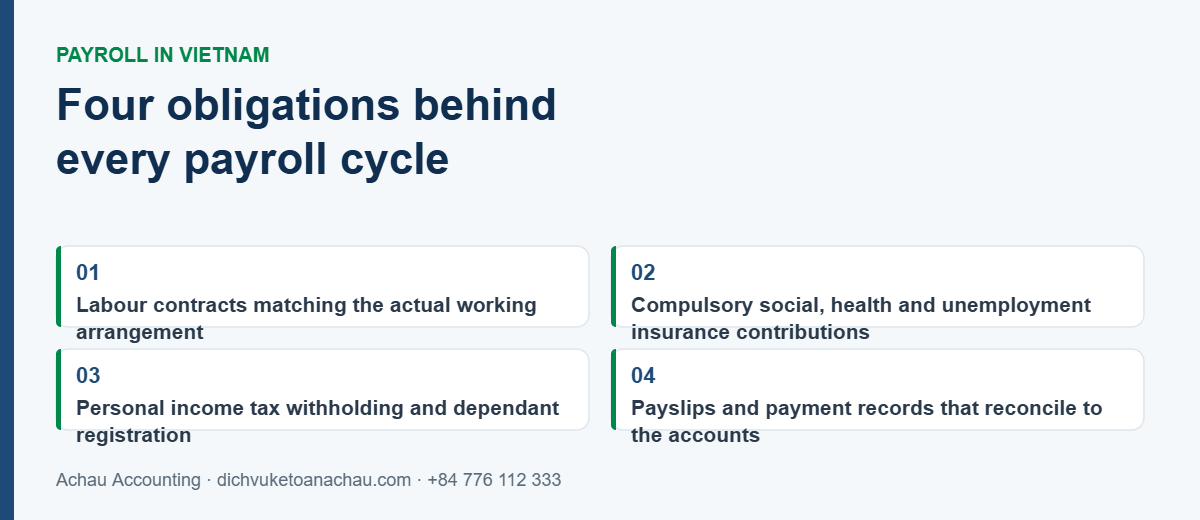
Within 30 days of signing the first labor contract, the employer must register with the provincial Social Insurance office. The registration dossier includes:
- Enterprise Registration Certificate (ERC) and Investment Registration Certificate (IRC)
- Labor usage declaration (Form No. 01/PLI)
- List of employees with signed labor contracts
- Employee SI books (so BHXH) — or application for first-time issuance
Step 2: Register PIT Tax Code for Each Employee
Every employee must have a personal tax identification number (TIN / ma so thue ca nhan). The employer withholds PIT monthly, declares quarterly (or monthly if PIT liability exceeds VND 50 million/month), and issues annual PIT withholding certificates by March 31 of the following year.
Step 3: Monthly Payroll Processing
Each month, the employer calculates:
- Gross salary per the labor contract
- Mandatory insurance contributions (employer portion) — accrued as expense
- Employee insurance deductions (10.5%) — withheld from net salary
- PIT withholding — based on progressive table (residents) or 20% (non-residents)
- Trade union fee — 2% of the SI contribution base, paid to the trade union account
Step 4: File Monthly/Quarterly Reports
| Report | Frequency | Deadline | Authority |
|---|---|---|---|
| SI/HI/UI contribution declaration (Form D02-LT) | Monthly | Last day of the following month | Social Insurance Office |
| PIT declaration (Form 05/KK-TNCN) | Monthly or Quarterly | 20th of following month (monthly) or 30th of quarter-end month + 1 (quarterly) | Tax Office |
| Labor usage report (Form 01/PLI) | Semi-annual | June 5 and December 5 | DOLISA |
| Annual PIT finalization (Form 05/QTT-TNCN) | Annual | March 31 of the following year | Tax Office |
Need this handled for you? Á Châu provides accounting and bookkeeping services in Vietnam for foreign-invested and Vietnamese companies — statutory filings, reporting and inspection support. Call 0776 112 333.
Expatriate-Specific Payroll Considerations
Expatriate employees present additional payroll complexities that FDI companies must navigate carefully:
1. Work Permit Requirement
Before salary can be legally paid to a foreign employee, a valid work permit (or work permit exemption certificate) must be obtained. Employing a foreigner without a valid work permit can result in fines of VND 30–75 million and, in severe cases, deportation of the employee.
2. Social Insurance for Expatriates
Under Decree No. 143/2018/ND-CP, foreign employees working in Vietnam under a labor contract of 12 months or more are required to participate in social insurance (effective December 1, 2018). The SI component for expatriates covers:
- Sickness and maternity (3% employer)
- Occupational accidents and diseases (0.5% employer)
- Retirement and survivorship (14% employer + 8% employee)
Important: Expatriates are currently not required to participate in unemployment insurance (UI). Health insurance participation for expatriates follows separate regulations under Decree No. 146/2018/ND-CP.
3. Double Taxation Agreements (DTAs)
Vietnam has signed DTAs with over 80 jurisdictions. An expatriate who can prove tax residency in a DTA country may be entitled to reduced PIT rates or exemptions on certain income types. However, obtaining DTA benefits requires advance application to the tax authority — it is not automatic. Our team at BIZCA regularly assists FDI companies in structuring expatriate assignments to maximize DTA benefits.
Common Payroll Compliance Pitfalls for FDI Companies
Pitfall 1: Under-Declaring the Contribution Base Salary
Some employers attempt to reduce insurance costs by declaring a lower salary for SI purposes than the actual contractual salary. This is illegal and easily detected during Social Insurance inspections. Penalties include back-payment of underpaid contributions plus interest (approximately 0.03% per day) and administrative fines.
Pitfall 2: Misclassifying Employees as Independent Contractors
Vietnam’s labor authorities apply a “substance over form” test. If a “service provider” works exclusively for your company, follows your work schedule, and uses your equipment, they are likely an employee regardless of the contract label. Misclassification triggers back SI/HI/UI contributions for the entire engagement period — often years of arrears.
Pitfall 3: Late SI/HI/UI Contribution Payments
A single late payment triggers interest charges on the overdue amount. Chronic late payment — defined as owing contributions for 3 months or more — can lead to enforcement actions including bank account freezes, suspension of export-import activities, and even criminal liability for the legal representative under Article 216 of the Penal Code.
Pitfall 4: Incorrect PIT Withholding for Departing Expatriates
When an expatriate terminates employment and leaves Vietnam, the employer must perform PIT finalization within 45 days of termination. Failure to do so leaves the employer liable for any unpaid PIT, plus penalties. This is a common issue for project-based expatriate assignments where the exit date is not clearly tracked by HR.
Pitfall 5: Overlooking the 2026 Base Salary Increase
The base salary increased to VND 2,530,000 on July 1, 2026, which adjusts contribution ceilings upward. Companies that continue calculating on the old base (VND 2,340,000) will underpay contributions from July onward. Tai Chinh A Chau provides payroll recalculation services specifically for regulatory change events like this.
Outsourcing Payroll: When and Why FDI Companies Choose External Providers
Many FDI companies, particularly small and medium-sized enterprises, find that outsourcing payroll to a Vietnam-based accounting firm is more cost-effective than maintaining an in-house payroll department. Key advantages include:
- Regulatory currency: Providers stay continuously updated on legal changes — no risk of calculating on outdated contribution caps or tax tables
- Reduced headcount cost: A full payroll accountant costs VND 15–25 million/month in salary alone, before benefits. Outsourcing typically costs 30–50% less
- Insurance registration and claims support: Sick leave, maternity, and occupational accident claims involve detailed paperwork that a professional service handles daily
- Audit-ready records: Professional payroll providers maintain documentation that satisfies both internal audit and external inspection requirements
- Bilingual reporting: For FDI management teams that need payroll summaries in English while maintaining Vietnamese records for authorities
FAQ: Payroll & Social Insurance Vietnam for FDI
1. What is the total employer cost for an employee earning VND 20,000,000 per month in 2026?
On a salary of VND 20,000,000 (used as the SI contribution base), the employer contributes approximately VND 4,700,000 in mandatory insurance (23.5%) plus 2% trade union fee (VND 400,000). Total monthly employer cost: approximately VND 25,100,000. The employee receives net salary of approximately VND 15,800,000 after 10.5% insurance deductions and PIT withholding (assuming resident, single, no dependents).
2. Do we need to pay social insurance for foreign employees on short-term assignments (under 12 months)?
Foreign employees with a labor contract of less than 12 months are generally not required to participate in compulsory social insurance. However, if a series of short-term contracts cumulatively exceeds 12 months, the Social Insurance authority may reclassify the arrangement. We recommend consulting with an accounting professional to assess your specific situation.
3. Can we pay expatriate salaries in a foreign currency?
Salaries paid to foreign employees may be denominated and paid in a foreign currency if: (a) the labor contract specifies the foreign currency, and (b) the employee maintains a foreign currency bank account in Vietnam. However, for SI/HI/UI contribution purposes, the salary must be converted to VND at the exchange rate on the payment date. PIT is also calculated in VND.
4. What happens if an employee has two jobs in Vietnam — who pays the insurance?
The primary employer (under the main labor contract) is responsible for SI/HI/UI contributions on the full salary from that employment. The secondary employer does not pay SI/UI but must still withhold PIT at a flat 10% on the secondary income (after the PIT-free threshold is exceeded at the primary job). The employee is responsible for declaring both incomes at year-end PIT finalization.
5. Is the trade union fee mandatory even if we have no trade union in our company?
Yes. Under the Law on Trade Unions (2012), all enterprises with 10 or more employees must pay the trade union fee (2% of the SI contribution base) regardless of whether a trade union organization exists within the company. This is one of the most frequently overlooked obligations for FDI companies entering Vietnam.
Conclusion: Payroll Compliance as a Strategic Advantage
Payroll and social insurance compliance in Vietnam is complex but manageable with the right systems and expertise. For FDI companies, getting payroll right from the beginning delivers three strategic benefits: legal protection (no back-payment demands or fines), cost predictability (accurate budgeting of the 23.5% employer contribution burden), and employee trust (Vietnamese employees value proper SI book registration and transparent PIT reporting).
Whether you manage payroll in-house or engage a professional service provider, the key is to stay current with regulatory changes — and 2026 has brought significant updates that warrant a thorough review of your current payroll practices.
Need Payroll & Social Insurance Services for Your Vietnam Entity?
A Chau Accounting provides end-to-end payroll management for FDI companies — from registration and monthly processing to PIT finalization and Social Insurance claims. All services are delivered in English with bilingual reporting.
📞 +84 776 112 333 | ✉️ info@dichvuketoanachau.com
Explore the A Chau Ecosystem:
- Tai Chinh A Chau — Financial Advisory, Loans & Restructuring
- BIZCA — Business Networking Hub: Capital, M&A, Sales
- Dich Vu Ke Toan A Chau — Full Accounting & Assurance Services
Official regulatory sources: Vietnam Legal Documents (VBPL) · Thu Vien Phap Luat · Ministry of Finance
Related Guides
- Personal income tax for expatriates
- Corporate income tax (CIT) in Vietnam
- Vietnam Accounting Standards (VAS) & bookkeeping
- Accounting and bookkeeping services in vietnam
- Tax consulting services in vietnam
Related services
- Full-service accounting in Vietnam
- Corporate tax finalization service
- Tax consulting
- FDI and transfer pricing tax advisory
- Tax risk management advisory
Achau Accounting · 343 Pham Ngu Lao, Ben Thanh Ward, Ho Chi Minh City · +84 776 112 333 · linhcskh@dichvuketoanachau.com
More English guides: Accounting and tax guides for foreign companies in Vietnam — CIT, VAT, foreign contractor tax, payroll, e-invoicing and transfer pricing.
Á Châu khảo sát hồ sơ thực tế rồi tư vấn theo đúng tình hình của doanh nghiệp, không tư vấn theo quy định chung. Khảo sát sơ bộ không tính phí.
Gọi 0776 112 333Gửi yêu cầu tư vấn
Tra cứu nhanh: 30 câu hỏi thường gặp · Cẩm nang kế toán và thuế · Thư viện văn bản pháp luật
Need this handled for your company in Vietnam?
Three fields. An English-speaking adviser calls back within 4 working hours and sends a written quote within 24 hours. Bookkeeping from VND 500,000/month, priced on actual invoice volume.

