


Decree 132/2020/ND-CP and Decree 20/2025/ND-CP on tax administration for enterprises with related-party transactions have been replaced by Decree 255/2026/ND-CP, effective 1 July 2026 and applicable from the 2026 tax period. Several thresholds have changed — see the six key changes under Decree 255/2026.
For foreign enterprises operating in Vietnam, tax compliance is not just about filing on time — it’s about managing a complex web of regulations that can trigger audits, penalties, and reputational damage if mishandled. Vietnam’s tax authority (General Department of Taxation) has significantly stepped up its audit and inspection capacity, deploying data analytics and cross-referencing systems that make it easier than ever to flag discrepancies.
This guide covers the top tax risks for FDI companies in Vietnam, what triggers a tax audit, and how to build a robust compliance framework that keeps your business audit-ready.
Top 5 Tax Risks for FDI Companies in Vietnam
1. Transfer Pricing — Decree 255/2026/ND-CP
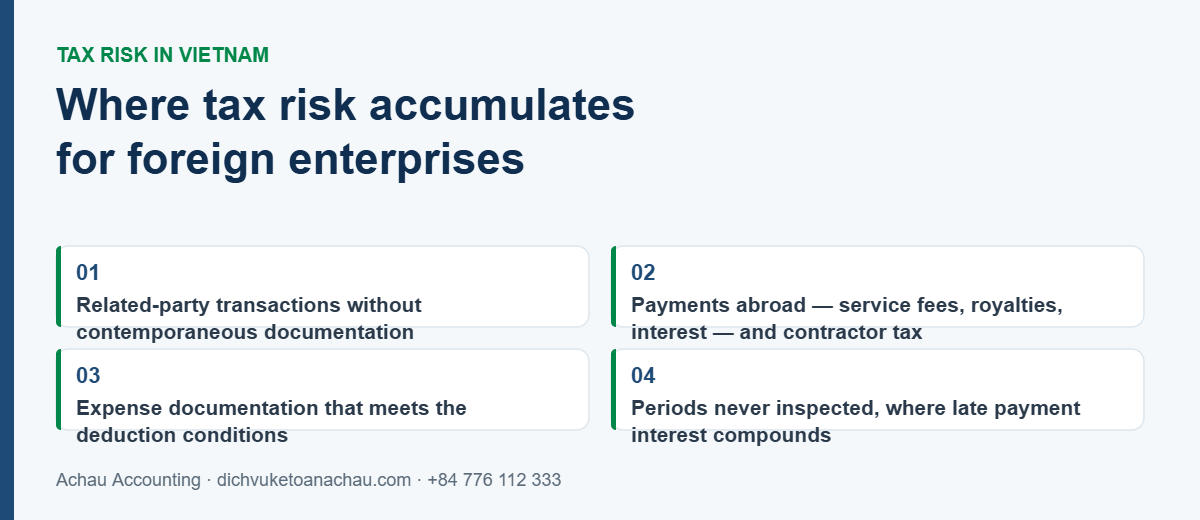
This is the #1 audit trigger for FDI companies. Vietnam applies the arm’s length principle strictly. Key thresholds that require transfer pricing documentation:
- Annual related-party transaction value exceeding 30 billion VND (~1.3M USD) in revenue, OR
- Total assets exceeding 50 billion VND (~2.2M USD) with related-party transactions over 5 billion VND
The 30% EBITDA interest deduction cap applies to all related-party loans. Companies must file Form 01 (related-party transaction disclosure) and Form 02 (transfer pricing documentation) annually.
2. Permanent Establishment (PE) Risk
Foreign companies without a registered entity in Vietnam can still create a PE — and become subject to Vietnamese CIT — if they:
- Have a dependent agent in Vietnam who habitually negotiates or signs contracts
- Provide services in Vietnam for more than 183 days in any 12-month period
- Maintain a fixed place of business (even a home office used consistently for business)
PE determination is highly fact-specific. The tax authority has been increasingly aggressive in asserting PE, particularly for digital economy and cross-border service providers.
3. VAT Refund Scrutiny
VAT refund claims are one of the most heavily scrutinized areas. The tax authority’s system automatically cross-checks:
- Input VAT invoices against the seller’s output VAT declarations (mismatch = automatic rejection)
- Bank payment records for transactions over 20 million VND (cash payments = no VAT deduction)
- Customs declarations for imported goods vs. claimed input VAT
A single mismatched invoice can delay your entire refund by 6-12 months.
4. Foreign Contractor Tax (FCT) Omissions
Many FDI companies unknowingly fail to withhold FCT on payments to overseas entities. Common triggers:
- Software license fees, SaaS subscriptions (5% VAT + 5% CIT)
- Management fees, technical service fees paid to parent company (5% VAT + 5% CIT)
- Royalties, trademark licenses (5% VAT + 10% CIT)
- Interest on related-party loans (5% CIT only, no VAT)
The obligation is on the Vietnamese payer to declare and remit FCT within 10 days of payment. Late or missed FCT = penalties + interest (0.03%/day).
5. Expense Deductibility — Overclaimed CIT Deductions
The tax authority routinely disallows expenses that lack proper documentation. Common rejections:
- Expenses without valid VAT invoices (electronic invoices with tax authority codes are mandatory since July 2022)
- Depreciation exceeding prescribed rates (Circular 45/2013/TT-BTC and amendments)
- Employee benefits exceeding the cap (total welfare expenses are capped at 1 month’s average actual salary)
- Provisions for bad debts, warranty, or inventory write-downs that do not meet the strict conditions of Circular 48/2019/TT-BTC
For the full conditions and the records that defend a deduction, see our guide to deductible expenses for CIT in Vietnam.
What Triggers a Tax Audit in Vietnam?
| Trigger | Risk Level | How to Avoid |
|---|---|---|
| Consistently reporting losses or very low profit margins vs. industry peers | 🔴 High | Maintain transfer pricing documentation; benchmark margins against industry |
| Large VAT refund claims (especially 1+ billion VND/month) | 🔴 High | Pre-audit your input invoices; ensure all supporting documents match |
| Significant related-party transactions | 🔴 High | Prepare annual TP documentation; apply arm’s length pricing |
| Revenue growth without corresponding CIT increase | 🟡 Medium | Document all deductible expenses thoroughly |
| Late or amended tax declarations (more than 2 amendments/year) | 🟡 Medium | File correctly the first time; double-check before submission |
| High ratio of input VAT / output VAT | 🟡 Medium | Monitor VAT ratio monthly; flag abnormal patterns early |
| Employee complaints or whistleblower reports | 🔴 High | Maintain proper payroll records; file all social insurance on time |
Penalties Under Decree 125/2020/ND-CP
| Violation | Penalty Range |
|---|---|
| Late tax declaration (1-30 days) | 2,000,000 – 5,000,000 VND |
| Late tax declaration (31-90 days) | 5,000,000 – 25,000,000 VND |
| Underdeclared tax (voluntary correction before audit) | 20% of underpaid tax + late interest 0.03%/day |
| Underdeclared tax (discovered by tax authority) | 1-3 times the underpaid tax amount + interest |
| Tax evasion (deliberate acts) | 1-3 times the evaded tax amount + criminal prosecution for large cases |
| Incorrect invoice issuance | 1,000,000 – 8,000,000 VND per invoice |
Need this handled for you? Á Châu provides tax consulting services in Vietnam for foreign-invested and Vietnamese companies — statutory filings, reporting and inspection support. Call 0776 112 333.
Pre-Audit Health Check: 10-Point Checklist
Before the tax authority comes knocking, run this self-assessment:
- ✅ Are all VAT invoices matched between input and output in the tax authority’s system?
- ✅ Are all FCT obligations identified and declared on time for cross-border payments?
- ✅ Is transfer pricing documentation (Forms 01 & 02) up-to-date and consistent with financial statements?
- ✅ Are salary payments, PIT withholding, and social insurance contributions fully reconciled?
- ✅ Are related-party transactions documented with contracts, pricing justification, and benchmarking?
- ✅ Are all fixed asset depreciation rates aligned with Circular 45/2013/TT-BTC?
- ✅ Are deductible expenses supported by valid e-invoices and bank transfer records (>20M VND)?
- ✅ Is the foreign currency accounting method (actual rate vs. BIDV rate) consistently applied?
- ✅ Are CIT provisional quarterly payments at least 80% of the final annual CIT liability?
- ✅ Is the e-invoice system transmitting data to the tax authority within the required timeframe?
Building Internal Tax Controls: A 4-Layer Framework
- Preventive Controls: Written tax policies, documented approval workflows for expenses and cross-border payments, standardized contract review for tax implications.
- Detective Controls: Monthly reconciliation of VAT input/output, quarterly variance analysis (revenue vs. CIT, payroll vs. PIT), automated invoice validation.
- Corrective Controls: Amended declaration protocol, penalty mitigation process, voluntary disclosure procedure.
- Governance: Quarterly tax compliance review with management, annual external health check, documented audit trail for all tax positions.
Is Your Vietnam Entity Audit-Ready?
Á Châu Accounting offers a Tax Health Check service: we review your last 12 months of tax filings, identify exposure areas, and deliver an actionable remediation plan — all before the tax authority comes knocking.
📞 Hotline: +84 776 112 333 | ✉️ Email: info@dichvuketoanachau.com
Official sources: Vietnam Legal Documents · General Department of Taxation
Related resources in our ecosystem:
- Tài Chính Á Châu — Financial Advisory & Risk Management — corporate restructuring, debt advisory, and financial risk management for FDI companies
- BIZCA — Business Services & Compliance Network — legal, tax, and M&A advisory for businesses in Vietnam
Frequently Asked Questions
How often does Vietnam conduct tax audits on FDI companies?
There is no fixed schedule. However, the tax authority’s risk-based selection system typically flags companies for audit within 3-5 years of operation. High-risk indicators (consistent losses, large refund claims, related-party transactions) can trigger earlier audits. An audit can cover up to 5 previous tax years.
Can I negotiate with the tax authority during an audit?
Yes. The audit process in Vietnam is adversarial but allows discussion. You have the right to explain your tax positions, present supporting documents, and appeal findings. Having a professional tax agent or accounting firm represent you significantly improves outcomes — they understand the technical language and procedural nuances.
What is the statute of limitations for tax liabilities in Vietnam?
The tax authority can assess back taxes within 10 years for transfer pricing cases (Decree 255/2026) and 5 years for general tax violations under the Law on Tax Administration No. 38/2019/QH14.
Should FDI companies file protective amended returns?
If you identify an error before the tax authority does, filing a voluntary amended declaration is significantly better. The penalty is capped at 20% of the underpaid tax (vs. 1-3 times if discovered by authorities). Include a clear explanation and all supporting documents.
Related Guides
- FDI audit readiness checklist
- Foreign contractor tax in Vietnam
- Accounting & bookkeeping review: are you audit-ready?
- Accounting and bookkeeping services in vietnam
- Tax consulting services in vietnam
Related services
- Full-service accounting in Vietnam
- Corporate tax finalization service
- Tax consulting
- FDI and transfer pricing tax advisory
- Tax risk management advisory
Achau Accounting · 343 Pham Ngu Lao, Ben Thanh Ward, Ho Chi Minh City · +84 776 112 333 · linhcskh@dichvuketoanachau.com
Related reading: Six key changes under Decree 255/2026 · The 30% EBITDA interest cap · Transfer pricing documentation service
Related reading: Decree 255/2026: what changed for related-party transactions · Vietnam’s 30% EBITDA interest cap · Transfer pricing documentation service
More English guides: Accounting and tax guides for foreign companies in Vietnam — CIT, VAT, foreign contractor tax, payroll, e-invoicing and transfer pricing.
Quick answers: Twenty questions foreign finance teams ask about Vietnamese tax and accounting.
Á Châu khảo sát hồ sơ thực tế rồi tư vấn theo đúng tình hình của doanh nghiệp, không tư vấn theo quy định chung. Khảo sát sơ bộ không tính phí.
Gọi 0776 112 333Gửi yêu cầu tư vấn
Tra cứu nhanh: 30 câu hỏi thường gặp · Cẩm nang kế toán và thuế · Thư viện văn bản pháp luật
Need this handled for your company in Vietnam?
Three fields. An English-speaking adviser calls back within 4 working hours and sends a written quote within 24 hours. Bookkeeping from VND 500,000/month, priced on actual invoice volume.

