


Decree 132/2020/ND-CP and Decree 20/2025/ND-CP on tax administration for enterprises with related-party transactions have been replaced by Decree 255/2026/ND-CP, effective 1 July 2026 and applicable from the 2026 tax period. Several thresholds have changed — see the six key changes under Decree 255/2026.
When a foreign company provides services to a Vietnam-based entity — whether it is a subsidiary, a joint venture, or a local client — the transaction often triggers Foreign Contractor Tax (FCT). This unique tax regime, governed primarily by Circular 103/2014/TT-BTC, imposes both VAT and corporate income tax on foreign contractors earning income from Vietnam without establishing a legal presence in the country. For FDI enterprises operating in Vietnam, understanding FCT is not optional: misclassification or failure to withhold can result in penalties of up to 20% of the underpaid tax amount under Decree 125/2020/NĐ-CP. This guide breaks down FCT rates, calculation methods, withholding obligations, double tax agreement (DTA) relief, and practical compliance steps for 2026.
What Is Foreign Contractor Tax (FCT)?
Foreign Contractor Tax is not a separate tax law but a withholding mechanism embedded in Vietnam’s VAT and corporate income tax (CIT) frameworks. When a foreign organization or individual earns income from Vietnam without having a permanent establishment (PE) in the country, the Vietnamese contracting party is required to withhold and remit FCT on their behalf before making payment. The legal basis is Circular 103/2014/TT-BTC, which consolidates earlier regulations and remains the primary reference for FCT compliance.
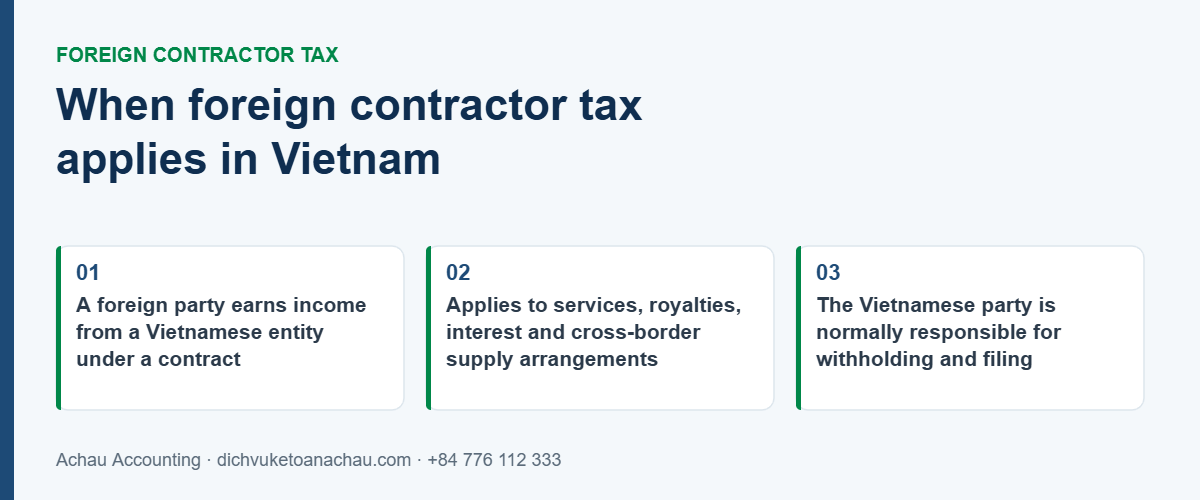
FCT applies to a wide range of cross-border transactions: service contracts, equipment rentals, software licensing, management fees, royalties, interest payments, and even certain goods supplied in combination with services in Vietnam. The key principle is that the source of income is Vietnam — either because the service is performed in Vietnam or because the payment originates from a Vietnam-based entity. For FDI companies, this often arises in scenarios such as paying overseas parent company management fees, licensing technology from foreign affiliates, or engaging foreign consultants for projects in Vietnam.
It is worth noting that FCT operates on a gross-revenue basis by default, meaning the tax is calculated on the total contract value rather than net profit. This distinguishes it from the regular CIT regime, where expenses are deductible. However, foreign contractors can opt for the declaration method (deduction method) if they meet specific criteria — including having a PE in Vietnam or operating under a long-term contract exceeding 183 days — allowing them to file Vietnamese CIT and VAT returns based on actual revenue and expenses.
Who Is Subject to Foreign Contractor Tax?
FCT applies when three conditions are simultaneously met:
- The service provider is a foreign entity or individual — a company incorporated outside Vietnam, or a non-resident individual performing work in Vietnam.
- The foreign contractor earns income from Vietnam — the payment is made by a Vietnamese organization or individual, or the service is performed within Vietnam’s territory.
- The income falls under FCT scope — including but not limited to: service fees, interest, royalties, equipment rental (operating lease), insurance premiums, transportation fees, construction and installation contracts, and software licensing.
Who is NOT subject to FCT? Pure goods supply contracts (where title transfers outside Vietnam and no accompanying services are performed in Vietnam) are generally exempt. Similarly, dividends paid by a Vietnamese subsidiary to its foreign parent are not subject to FCT — though they may be subject to separate withholding tax treatment under the Law on Corporate Income Tax or an applicable DTA.
For FDI enterprises, the most common FCT scenarios include:
- Paying management service fees to the overseas head office or regional headquarters
- Royalty payments for technology transfer, brand licensing, or franchise fees
- Interest on cross-border loans from foreign shareholders or related parties
- Technical service fees for equipment maintenance, software implementation, or training provided by foreign specialists visiting Vietnam
- Consulting fees paid to foreign advisors, law firms, or engineering firms with no Vietnam office
FCT Rates: How Much Tax to Withhold
FCT rates vary significantly depending on the nature of the transaction. Below is the authoritative rate table based on Circular 103/2014/TT-BTC, effective as of 2026:
| Type of Income | VAT Rate | CIT Rate | Total FCT |
|---|---|---|---|
| Services (general) | 5% | 5% | 10% |
| Services (together with goods supply) | 3% | 2% | 5% |
| Goods supply (in Vietnam, with services) | Exempt or 3% | 1% | 1–4% |
| Interest (cross-border loans) | Exempt | 5% | 5% |
| Royalties | Exempt | 10% | 10% |
| Equipment rental (operating lease) | 5% | 5% | 10% |
| Construction & installation | 5% | 2% | 7% |
| Transportation | Exempt or 3% | 2% | 2–5% |
| Insurance (cross-border) | Exempt or 5% | 5% | 5–10% |
| Securities transfer / capital assignment | Exempt | 0.1% of sale price | 0.1% |
Important: The above rates apply under the direct method (gross-revenue basis). If the foreign contractor qualifies for the deduction method and elects to register for VAT and CIT in Vietnam, the standard rates of 10% VAT and 20% CIT apply — but on net profit (revenue minus deductible expenses). This is often more favorable for contractors with significant input costs.
Calculation Example
Scenario: A Singapore-based consulting firm provides management advisory services to a Vietnamese FDI subsidiary. The contract value is USD 100,000. The firm has no PE in Vietnam.
- VAT (5%): USD 100,000 × 5% = USD 5,000
- CIT (5%): USD 100,000 × 5% = USD 5,000
- Total FCT: USD 10,000
- Net payment to contractor: USD 90,000
If the contract is structured on a net basis (i.e., the contractor receives USD 100,000 after tax), the Vietnamese party must gross up the payment. In this case, the taxable revenue = USD 100,000 ÷ (1 − 10%) = USD 111,111. The Vietnamese party remits USD 11,111 in FCT and pays USD 100,000 net to the contractor.
Withholding and Declaration Obligations
The Vietnamese contracting party bears primary responsibility for FCT compliance. Key obligations include:
- Register FCT withholding with the local tax authority before the first payment. This requires submitting Form 04-ĐK-TCT (tax registration) specifying the foreign contractor details, contract value, and applicable FCT rates.
- Withhold FCT from each payment to the foreign contractor. The withholding must occur at the time of payment — not at the time of invoicing or contract signing.
- File FCT declarations using Form 01/NTNN on a per-contract, per-payment basis. Declarations must be submitted within 10 days of each payment date.
- Remit FCT to the state budget within the same 10-day deadline following each payment.
- Issue FCT payment vouchers to the foreign contractor as proof of tax paid, which the contractor may use to claim DTA relief or foreign tax credits in their home jurisdiction.
Foreign contractors that operate in Vietnam for 183 days or more in a calendar year — or maintain a fixed place of business — may trigger permanent establishment (PE) status. Once PE is established, the contractor shifts from FCT withholding to the regular VAT and CIT declaration regime, filing quarterly and annual returns with the tax authority directly. This is a critical threshold for FDI groups with rotating expatriate staff or multi-phase projects spanning more than six months.
Need this handled for you? Á Châu provides tax consulting services in Vietnam for foreign-invested and Vietnamese companies — statutory filings, reporting and inspection support. Call 0776 112 333.
Double Tax Agreement (DTA) Relief
Vietnam has signed DTAs with over 80 countries, including major trade partners such as Japan, South Korea, Singapore, the UK, Germany, Australia, and the United States (though the US-Vietnam DTA is limited in scope). A DTA can reduce or eliminate the CIT component of FCT — but NOT the VAT component. To claim DTA benefits, the foreign contractor must:
- Be a tax resident of the DTA partner country (certified by the foreign tax authority)
- Not have a PE in Vietnam — DTA relief typically applies only to business profits not attributable to a Vietnamese PE
- Submit DTA notification (Form 01/DTA-NTNN) to the Vietnamese tax authority before the first payment, accompanied by a Certificate of Tax Residence (COR) from the contractor’s home country
- Meet beneficial ownership and substance requirements — increasingly scrutinized under Vietnam’s implementation of BEPS (Base Erosion and Profit Shifting) standards
CIT rates under select DTAs (services/royalties):
| Country | CIT on Services | CIT on Royalties | CIT on Interest |
|---|---|---|---|
| Singapore | Exempt (no PE) | 5–10% | 5% |
| South Korea | Exempt (no PE) | 5–10% | 5% |
| Japan | Exempt (no PE) | 10% | 5% |
| United Kingdom | Exempt (no PE) | 10% | 5% |
| Germany | Exempt (no PE) | 10% | 5% |
| China | Exempt (no PE) | 10% | 5% |
| Thailand | Exempt (no PE) | 15% | 10% |
Practical tip: Most DTAs exempt business profits (service fees) from Vietnamese CIT entirely — provided the foreign contractor has no PE. This means FCT on services can effectively drop from 10% to 5% (VAT only) when DTA relief is properly claimed. However, the administrative burden is real: the COR must be renewed annually, and some tax authorities now require notarized Vietnamese translations of foreign-language CORs.
Common FCT Pitfalls for FDI Enterprises
FCT is one of the most frequently audited areas in Vietnam, particularly for FDI companies with related-party transactions. Below are the most common pitfalls and how to avoid them:
1. Misclassifying Service Contracts as Pure Goods Supply
Some enterprises attempt to structure cross-border payments as goods purchases to avoid FCT. Tax auditors examine the substance of the contract — not just its title. If a “goods supply” contract includes any element of installation, training, warranty service, or technical support performed in Vietnam, the transaction may be reclassified as a composite service subject to FCT. Always segregate goods and services components in separate contracts with clear deliverables.
2. Overlooking PE Triggers
Foreign personnel working in Vietnam for extended periods — even on short, repeated visits — can inadvertently create a PE. Under Circular 103 and applicable DTAs, a building site or construction project exceeding 6 months, or the presence of employees for more than 183 days in any 12-month period, may constitute a PE. Once PE is triggered, the contractor must register, file, and pay tax directly — and prior-period FCT filings by the withholding method may be challenged. Track cross-border personnel movements meticulously.
3. Incorrect Gross-Up Calculation
When contracts specify a net amount payable to the foreign contractor, the gross-up calculation must factor in both VAT and CIT components. A common error is grossing up only for CIT (5%) and forgetting VAT (5%). The correct formula is: Taxable Revenue = Net Amount ÷ (1 − Composite FCT Rate).
4. Late Payment of Withheld FCT
The 10-day deadline for FCT remittance is strict. Late payment interest accrues at 0.03% per day (approximately 10.95% per annum) under the Law on Tax Administration 2019. For a USD 500,000 contract with USD 50,000 FCT, a 30-day delay adds USD 450 in late-payment interest — but more critically, it triggers non-compliance flags that can escalate into a full tax audit.
5. Missing DTA Documentation at Contract Signing
DTA relief must be claimed before the first payment, not retroactively. If a Vietnamese party withholds FCT at the full rate (e.g., 5% CIT) because no COR was provided, the foreign contractor cannot later reclaim the overpaid CIT from the Vietnamese tax authority — it must seek a foreign tax credit in its home jurisdiction, which may be limited or unavailable.
FCT Compliance Checklist for 2026
Use this checklist before signing or renewing any cross-border contract with a foreign service provider:
- □ Classify the transaction — pure goods, pure services, or composite? Determine applicable FCT rates.
- □ Check DTA applicability — is the contractor resident in a DTA country? Obtain a valid COR before the first payment.
- □ Assess PE risk — will the contractor’s personnel spend more than 183 days in Vietnam? If yes, prepare for declaration-method registration.
- □ Confirm contract structure — is the price stated gross or net? Calculate gross-up if needed and specify clearly in the contract.
- □ Register FCT withholding — file Form 04-ĐK-TCT with the local tax authority before any payment is made.
- □ Set up payment calendar — ensure FCT declarations (Form 01/NTNN) are filed within 10 days of each payment milestone.
- □ Maintain records — retain contracts, invoices, DTA CORs, FCT payment vouchers, and bank remittance confirmations for at least 10 years.
- □ Review related-party transactions annually — FCT on related-party payments receives heightened audit scrutiny; ensure transfer pricing documentation is also in order under Decree 255/2026/NĐ-CP.
Need Help with Foreign Contractor Tax Compliance?
Á Châu’s accounting team manages FCT withholding, DTA documentation, and cross-border payment compliance for FDI enterprises in Vietnam. We handle the paperwork, deadlines, and tax authority communication — so your international transactions stay compliant.
📞 +84 776 112 333 | ✉️ info@dichvuketoanachau.com
📍 343 Phạm Ngũ Lão, Phường Bến Thành, TP. Hồ Chí Minh
🔗 Explore the Á Châu Ecosystem:
- Tài Chính Á Châu — Financial Advisory & Corporate Finance — Expertise in cross-border transaction structuring, loan advisory, and financial due diligence for FDI enterprises navigating Vietnam’s tax landscape.
- BIZCA — Business Networking & M&A Hub — Connect with foreign contractors, legal advisors, and tax specialists in the Á Châu business ecosystem for your Vietnam operations.
- Dịch Vụ Kế Toán Á Châu (.vn) — Vietnamese-language accounting, tax compliance, and FCT services for foreign enterprises operating in Vietnam.
Official Sources: VBPL — Vietnam Laws Portal · Vietnam Government Portal · Ministry of Finance Portal
Frequently Asked Questions
1. Is FCT a separate tax, or is it just a collection method?
FCT is a withholding mechanism, not a standalone tax law. It collects VAT and CIT on behalf of foreign contractors who lack a Vietnamese tax presence. The underlying tax categories remain VAT and CIT; FCT simply designates the Vietnamese contracting party as the withholding agent.
2. Can a foreign contractor reclaim VAT paid under FCT?
Under the direct method (gross-revenue basis), no — the 5% VAT on services is final and non-refundable. However, if the contractor registers for the deduction method (having a PE or meeting 183-day criteria), input VAT on eligible expenses can be credited against output VAT. For contractors in DTA countries, the CIT component may be eliminated but the VAT component remains payable.
3. What happens if the Vietnamese party fails to withhold FCT?
The Vietnamese contracting party bears joint liability. Under Decree 125/2020/NĐ-CP, failure to withhold FCT results in a penalty of 20% of the underpaid tax amount, plus late-payment interest at 0.03% per day. In severe cases, the tax authority can also disallow the entire contract payment as a deductible expense for CIT purposes, resulting in additional CIT at 20% — effectively a triple penalty.
4. Does FCT apply to software-as-a-service (SaaS) subscriptions?
Yes, generally. SaaS and cloud-based software subscriptions paid to foreign providers are classified as services under Circular 103 and are subject to FCT at the standard 10% composite rate (5% VAT + 5% CIT). However, some tax authorities may treat pure software licenses (one-time purchase, no ongoing service) as royalties (5% VAT exempt + 10% CIT), which yields the same total rate. The distinction matters for DTA purposes, as many DTAs cap royalty withholding at lower rates.
5. Can we net FCT obligations across multiple contracts with the same foreign contractor?
No. FCT is assessed per contract, per payment. Each contract is independently classified, and FCT rates are determined by the nature of the income under that specific contract. You cannot offset a CIT overpayment on one contract against a VAT underpayment on another — each requires its own Form 01/NTNN declaration and separate remittance.
Related Guides
- Corporate income tax (CIT) in Vietnam
- Transfer pricing compliance under Decree 255/2026
- Tax risk management for foreign enterprises
- Accounting and bookkeeping services in vietnam
- Tax consulting services in vietnam
Related services
- Full-service accounting in Vietnam
- Corporate tax finalization service
- Tax consulting
- FDI and transfer pricing tax advisory
- Tax risk management advisory
Achau Accounting · 343 Pham Ngu Lao, Ben Thanh Ward, Ho Chi Minh City · +84 776 112 333 · linhcskh@dichvuketoanachau.com
Related reading: Six key changes under Decree 255/2026 · The 30% EBITDA interest cap · Transfer pricing documentation service
Related reading: Decree 255/2026: what changed for related-party transactions · Vietnam’s 30% EBITDA interest cap · Transfer pricing documentation service
More English guides: Accounting and tax guides for foreign companies in Vietnam — CIT, VAT, foreign contractor tax, payroll, e-invoicing and transfer pricing.
Á Châu khảo sát hồ sơ thực tế rồi tư vấn theo đúng tình hình của doanh nghiệp, không tư vấn theo quy định chung. Khảo sát sơ bộ không tính phí.
Gọi 0776 112 333Gửi yêu cầu tư vấn
Tra cứu nhanh: 30 câu hỏi thường gặp · Cẩm nang kế toán và thuế · Thư viện văn bản pháp luật
Need this handled for your company in Vietnam?
Three fields. An English-speaking adviser calls back within 4 working hours and sends a written quote within 24 hours. Bookkeeping from VND 500,000/month, priced on actual invoice volume.

