


Decree 132/2020/ND-CP and Decree 20/2025/ND-CP on tax administration for enterprises with related-party transactions have been replaced by Decree 255/2026/ND-CP, effective 1 July 2026 and applicable from the 2026 tax period. Several thresholds have changed — see the six key changes under Decree 255/2026.
For foreign-invested enterprises (FDI) operating in Vietnam, transfer pricing remains one of the highest-risk areas of tax compliance. The Vietnamese tax authorities — led by the General Department of Taxation (GDT) — have significantly intensified transfer pricing audits since the introduction of Decree 255/2026/ND-CP, which took effect on December 20, 2020. This decree consolidates and strengthens Vietnam’s transfer pricing regulations, aligning them more closely with OECD BEPS standards while imposing uniquely Vietnamese requirements that foreign companies often overlook. This comprehensive guide covers everything FDI enterprises need to know about transfer pricing compliance in Vietnam in 2026.
What Is Decree 255/2026/ND-CP?
Decree 255/2026/ND-CP is Vietnam’s primary legal instrument governing transfer pricing. It replaced Decree 20/2017/ND-CP and Decree 68/2020/ND-CP, creating a single, unified framework. The decree applies to all enterprises operating in Vietnam that engage in related-party transactions, including:
- FDI enterprises transacting with parent companies or overseas affiliates
- Vietnamese subsidiaries of multinational groups
- Enterprises with common management, control, or capital ties
- Enterprises with related-party lending arrangements
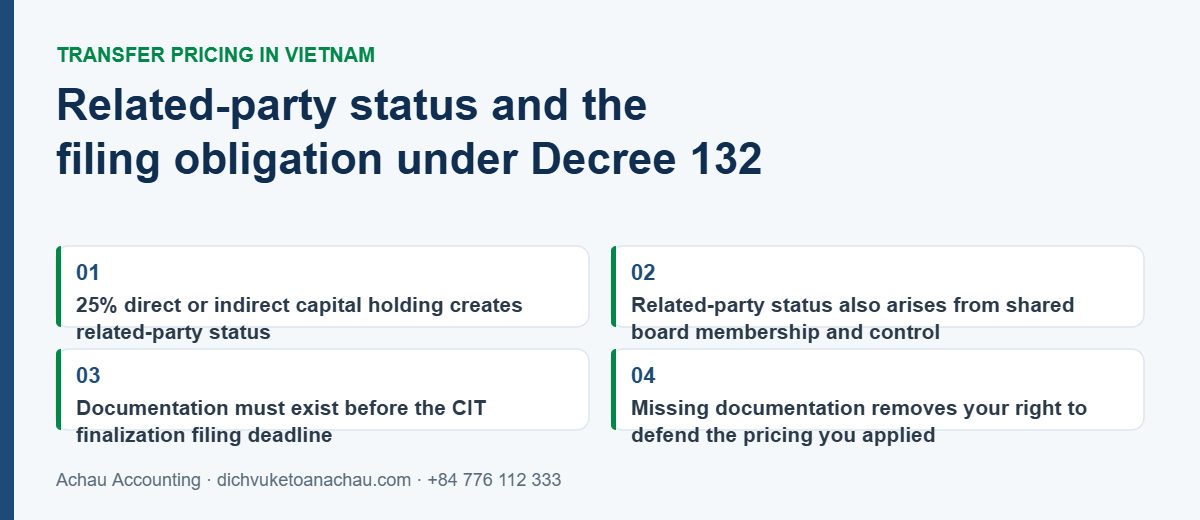
Under Decree 255, two parties are considered related if one party holds, directly or indirectly, at least 25% of the equity of the other, or if a third party holds at least 25% of both. Related-party status also arises from common board membership, shared management control, significant supplier/customer relationships, and various other connection criteria defined in Article 5 of the decree.
The Arm’s Length Principle
At the core of Decree 255 is the Arm’s Length Principle (ALP), consistent with the OECD Transfer Pricing Guidelines. The principle requires that transactions between related parties be priced as if they were conducted between independent entities under comparable circumstances. This means:
- Prices, profit margins, and profit allocation must reflect what independent parties would agree to in the open market
- Tax authorities can adjust taxable income when related-party transactions diverge from arm’s length prices
- The burden of proof rests with the taxpayer to demonstrate arm’s length compliance
Vietnam recognizes five transfer pricing methods, ranked in order of preference:
- Comparable Uncontrolled Price (CUP) — comparing the related-party price to prices in comparable uncontrolled transactions
- Resale Price Method (RPM) — based on the resale price to independent parties minus an appropriate gross margin
- Cost Plus Method (CP) — based on costs incurred plus an appropriate mark-up
- Profit Split Method (PSM) — allocating combined profits based on relative contributions
- Transactional Net Margin Method (TNMM) — comparing net profit margins to comparable independent companies
Transfer Pricing Documentation: The Three-Tier Framework
Decree 255 mandates a three-tier documentation framework aligned with OECD BEPS Action 13. The scope depends on the size and nature of the enterprise:
1. Local File
The Local File is mandatory for all enterprises with related-party transactions. It must include:
- Detailed description of the enterprise’s organizational structure, business operations, and industry overview
- Analysis of related-party relationships and transaction types
- Functional analysis identifying functions performed, assets used, and risks assumed
- Comparability analysis and transfer pricing method selection
- Financial information and profit level indicators
2. Master File
The Master File is required for enterprises that are members of a multinational group. It provides a high-level overview of the global business operations and transfer pricing policies, including:
- Organizational structure of the multinational group
- Description of the group’s business and overall transfer pricing policies
- Overview of the group’s intangibles and R&D activities
- Intercompany financial activities
- Group financial and tax positions
3. Country-by-Country Report (CbCR)
The CbCR is required for multinational groups with consolidated group revenue of EUR 750 million or more. The ultimate parent entity must file the CbCR with its home tax authority, which exchanges the information with Vietnam under OECD automatic exchange agreements. The report breaks down revenue, profit, tax paid, employee count, and assets for each jurisdiction where the group operates.
Interest Deductibility Cap: The 30% EBITDA Rule
One of the most impactful provisions of Decree 255 for FDI enterprises is the interest deductibility cap. Under Article 16, the total interest expense deductible for corporate income tax purposes is capped at 30% of EBITDA (Earnings Before Interest, Taxes, Depreciation, and Amortization). Key points:
| Aspect | Detail |
|---|---|
| Cap Rate | 30% of EBITDA |
| Scope | Interest on loans from both related and independent parties |
| Carry-Forward | Non-deductible interest can be carried forward for up to 5 consecutive years, provided the 30% cap is not exceeded in the carry-forward year |
| Exemptions | Credit institutions; enterprises with related-party loans under VND 500 million; certain government-guaranteed loans |
| Calculation Period | Based on the financial year’s total EBITDA and total interest expense |
Practical implication: Thinly capitalized FDI enterprises with high debt-to-equity ratios must carefully model their interest deductions. Many foreign-invested companies in manufacturing, real estate, and infrastructure sectors have been caught off-guard by this rule, facing substantial CIT adjustments during audits.
Key Compliance Deadlines
| Obligation | Deadline |
|---|---|
| Annual CIT Finalization | Last day of the 3rd month after financial year-end (March 31 for calendar-year taxpayers) |
| Transfer Pricing Declaration (Form 01) | Filed together with annual CIT finalization return |
| Transfer Pricing Documentation (Local File + Master File) | Prepared before the annual CIT finalization filing deadline; submitted upon tax authority request within 30 working days |
| CbCR Notification (Form 04) | Last day of the financial year-end month (December 31 for calendar year) |
| CbCR Submission | 12 months after the financial year-end |
Need this handled for you? Á Châu provides transfer pricing and tax advisory for FDI for foreign-invested and Vietnamese companies — statutory filings, reporting and inspection support. Call 0776 112 333.
Penalties Under Decree 125/2020/ND-CP
Non-compliance with transfer pricing regulations attracts administrative penalties under Decree 125/2020/ND-CP (amended by Decree 102/2021/ND-CP):
- Late declaration filing: VND 2–25 million depending on the delay period
- Incorrect declaration leading to underpaid tax: 20% of the underpaid tax amount, plus the tax deficiency
- Failure to prepare transfer pricing documentation: VND 8–15 million for the Local File; additional VND 5–10 million for failure to provide upon request
- Transfer pricing adjustment: Tax authority can impose CIT, VAT, and FCT adjustments with late payment interest (0.03% per day) for up to 10 years in cases of transfer pricing violations
- In severe cases: Criminal penalties may apply under the Penal Code for tax evasion exceeding VND 100 million
Transfer Pricing Audit Triggers: What Draws Scrutiny
Based on GDT audit patterns observed through 2025–2026, the following factors significantly increase audit probability:
- Persistent losses despite growing revenue — the classic red flag for profit shifting
- High related-party transaction ratios (especially transactions with low-tax jurisdictions)
- Profit margins consistently below industry benchmarks
- Large management fee or royalty payments to overseas parents without clear benefit documentation
- Rapid shifts in functional profile or business model without corresponding transfer pricing policy updates
- Interest expenses exceeding 30% of EBITDA with improper documentation
- Operating in an industry sector under special scrutiny (currently: pharmaceuticals, electronics manufacturing, digital services)
Advance Pricing Agreements (APAs)
For FDI enterprises seeking certainty, Decree 255 provides the legal framework for Advance Pricing Agreements (APAs). An APA is a binding agreement between the taxpayer and the tax authority that pre-determines the transfer pricing methodology for a fixed period (typically 3–5 years). Benefits include:
- Elimination of transfer pricing audit risk for covered transactions
- Predictable tax treatment for long-term business planning
- Reduced compliance burden during the APA term
- Available in unilateral (taxpayer–Vietnam GDT), bilateral (Vietnam + one treaty partner), and multilateral formats
The APA application process is detailed in Circular 45/2021/TT-BTC and generally takes 12–24 months from application to conclusion. While Vietnam has been slower than regional peers in concluding APAs, the GDT has shown increased willingness since 2023, with several high-profile bilateral APAs completed with Japan, Korea, and Singapore.
Practical Action Plan for FDI Enterprises
- Map your related-party relationships. Identify all entities meeting the 25% ownership threshold and document the nature of every intercompany transaction — goods, services, royalties, interest, management fees.
- Perform an annual functional analysis. Review functions, assets, and risks for each entity in the Vietnam value chain. Changes in business operations should trigger an immediate transfer pricing review.
- Benchmark your margins. Run a comparability analysis using regional or domestic comparable companies. Ensure your profit margins fall within the interquartile range of comparable independent enterprises.
- Prepare documentation before the deadline. Don’t wait for a tax audit. Your Local File, Master File (if applicable), and supporting analyses should be complete before the CIT finalization deadline.
- Model your interest cap. For capital-intensive operations, project your EBITDA and interest expense across the year to identify potential non-deductibility early.
- Document the economic substance of all intercompany charges. Management fees, royalty payments, and shared service allocations must be supported by written agreements, benefit tests, and allocation keys that reflect actual consumption.
- Consider an APA for high-value transactions. If you have recurring related-party transactions exceeding VND 50 billion annually or operate in a high-risk sector, an APA may be the most cost-effective long-term compliance strategy.
Need Accounting & Assurance Services for Your Vietnam Entity?
Á Châu provides VAS-compliant bookkeeping, transfer pricing documentation, tax filing, payroll, and group reporting — all in English. Our team includes transfer pricing specialists with experience across manufacturing, trading, services, and digital economy sectors.
📞 +84 776 112 333 | ✉️ info@dichvuketoanachau.com
🌐 dichvuketoanachau.com
🔗 Explore the Á Châu Ecosystem:
- Tài Chính Á Châu — Financial Advisory, Corporate Finance & Loan Consulting
- BIZCA — Business Networking Hub: Capital, M&A, Services & Sales
- Dịch Vụ Kế Toán Á Châu (.vn) — Vietnamese Accounting Services Portal
Official Sources: VBPL — Vietnam Business & Law Portal · Thư Viện Pháp Luật · General Department of Taxation (GDT)
Frequently Asked Questions
1. What is the threshold for related-party status under Decree 255?
Under Article 5 of Decree 255/2026/ND-CP, two parties are related if one holds, directly or indirectly, at least 25% of the contributed capital of the other, or if a third party holds at least 25% of both. Related-party status also arises from shared board membership, significant vendor/customer relationships (over 50% of purchases or sales), or lending arrangements where the loan represents over 10% of equity or 50% of total medium/long-term debt.
2. Do small FDI enterprises need to prepare transfer pricing documentation?
Yes, but with carve-outs. Enterprises are exempt from preparing transfer pricing documentation if: (a) their total revenue is under VND 50 billion, (b) total value of related-party transactions is under VND 30 billion, (c) they have signed an APA and file annual APA compliance reports, or (d) they perform simple functions with revenue under VND 500 billion, no revenue or expenses from intangible assets, and a net operating profit margin before interest and tax of at least 5% (distribution), 10% (manufacturing) or 15% (toll manufacturing). However, even exempt entities must still declare related-party transactions on Form 01 and apply the arm’s length principle.
3. Can non-deductible interest from the 30% EBITDA cap be carried forward?
Yes. Under Article 16.3 of Decree 255, interest expense that exceeds the 30% EBITDA threshold in a given year can be carried forward and deducted in subsequent years for up to 5 consecutive years, provided the total interest deduction (current year + carried forward) does not exceed 30% of EBITDA in any carry-forward year. Unused amounts expire after the fifth year.
4. What is the penalty for not having transfer pricing documentation ready when requested?
If the tax authority requests transfer pricing documentation during an audit and the enterprise cannot provide it within 30 working days, the tax authority may impose a fine of VND 8–15 million for the Local File and an additional VND 5–10 million for failure to provide upon request. More critically, the authority can then unilaterally determine the arm’s length price using available data — which typically results in unfavorable tax adjustments, interest on underpaid tax (0.03% per day), and potential penalties of 20% of the deficiency.
5. Are digital services and e-commerce transactions subject to transfer pricing rules?
Yes. Decree 255 explicitly applies to all forms of related-party transactions, including digital services, software licensing, online advertising, data processing, and e-commerce platform fees. The GDT has increasingly focused on the digital economy, and Circular 18/2021/TT-BTC provides guidance on applying transfer pricing methods to intangible assets, intellectual property, and digital transactions. Multinational tech companies, SaaS providers, and digital platforms with Vietnam subsidiaries should ensure their intercompany pricing for IP, royalties, and service fees is fully documented and supported by a robust functional analysis.
Related Guides
- Foreign contractor tax in Vietnam
- Corporate income tax (CIT) in Vietnam
- Tax risk management for foreign enterprises
- Accounting and bookkeeping services in vietnam
- Tax consulting services in vietnam
Related services
- Full-service accounting in Vietnam
- Corporate tax finalization service
- Tax consulting
- FDI and transfer pricing tax advisory
- Tax risk management advisory
Achau Accounting · 343 Pham Ngu Lao, Ben Thanh Ward, Ho Chi Minh City · +84 776 112 333 · linhcskh@dichvuketoanachau.com
Related reading: Decree 255/2026: what changed for related-party transactions · Vietnam’s 30% EBITDA interest cap · Transfer pricing documentation service
More English guides: Accounting and tax guides for foreign companies in Vietnam — CIT, VAT, foreign contractor tax, payroll, e-invoicing and transfer pricing.
Quick answers: Twenty questions foreign finance teams ask about Vietnamese tax and accounting.
Á Châu khảo sát hồ sơ thực tế rồi tư vấn theo đúng tình hình của doanh nghiệp, không tư vấn theo quy định chung. Khảo sát sơ bộ không tính phí.
Gọi 0776 112 333Gửi yêu cầu tư vấn
Tra cứu nhanh: 30 câu hỏi thường gặp · Cẩm nang kế toán và thuế · Thư viện văn bản pháp luật
Need this handled for your company in Vietnam?
Three fields. An English-speaking adviser calls back within 4 working hours and sends a written quote within 24 hours. Bookkeeping from VND 500,000/month, priced on actual invoice volume.

