


For any foreign business operating in Vietnam, understanding Vietnamese Accounting Standards (VAS) is not optional — it’s a legal requirement. The Law on Accounting (No. 88/2015/QH13, amended 2024) and its guiding circulars create a comprehensive framework that governs how every enterprise must record, report, and retain financial information.
This guide provides a complete overview of VAS and bookkeeping requirements in 2026 — from the chart of accounts and e-invoice mandate to reporting deadlines and the latest regulatory updates.
What Are Vietnamese Accounting Standards (VAS)?
VAS consists of 26 individual standards (VAS 01 through VAS 26) issued by the Ministry of Finance, covering topics from inventory and fixed assets to revenue recognition and financial statement presentation. They are broadly based on older versions of IFRS but have been adapted to Vietnam’s economic context.
Key VAS standards foreign businesses must understand:
| Standard | Topic | Key Requirement |
|---|---|---|
| VAS 01 | Framework | Accrual basis, going concern, consistency, prudence |
| VAS 02 | Inventory | Lower of cost or net realizable value; FIFO or weighted average |
| VAS 03-04 | Fixed Assets | Historical cost; prescribed depreciation rates (Circular 45/2013) |
| VAS 10 | Forex | Transactions at actual rate or BIDV rate; monetary items revalued at year-end |
| VAS 14 | Revenue | Revenue recognized when risks/rewards transfer; specific rules for services, construction |
| VAS 17 | CIT | Current and deferred tax; temporary differences |
| VAS 21 | FS Presentation | Balance Sheet, Income Statement, Cash Flow, Notes — specific formats required |
| VAS 24 | Cash Flows | Direct method preferred; operating, investing, financing classification |
The Chart of Accounts: Circular 200/2014/TT-BTC vs. 133/2016/TT-BTC
Vietnam has a mandatory chart of accounts — you cannot create your own account numbers freely. The applicable circular depends on your enterprise type:
| Circular | Applies To | Chart of Accounts |
|---|---|---|
| Circular 200/2014/TT-BTC | All enterprises (including FDI) | Comprehensive: 9 account classes (100-900 series) |
| Circular 133/2016/TT-BTC | Small and medium enterprises (SMEs) | Simplified: 9 account classes with fewer sub-accounts |
9 Mandatory Account Classes (Circular 200):
- Class 100-199: Current Assets (cash, receivables, inventory)
- Class 200-299: Non-Current Assets (fixed assets, long-term investments)
- Class 300-399: Liabilities (payables, loans, provisions)
- Class 400-499: Owner’s Equity (capital, reserves, retained earnings)
- Class 500-599: Revenue
- Class 600-699: Operating Expenses (cost of goods sold, SG&A)
- Class 700-799: Other Income & Expenses
- Class 800-899: Tax Expense & Extraordinary Items
- Class 900-999: Off-Balance Sheet Items
E-Invoice Mandate: Decree 123/2020/ND-CP
Since July 1, 2022, all enterprises in Vietnam must use e-invoices with tax authority codes. Key requirements:
- Invoices are created, signed, and transmitted electronically through a system registered with the tax authority
- Each invoice receives a unique verification code from the tax authority’s system
- Invoice data is transmitted to the tax authority in real-time or within the required timeframe
- Paper invoices are no longer legally valid for any enterprise
- E-invoice data must be stored for 10 years minimum
Penalties for e-invoice violations (Decree 125/2020/ND-CP):
- Failure to issue e-invoice: 1,000,000 – 8,000,000 VND per invoice
- Issuing invoice with incorrect content: 500,000 – 1,500,000 VND per invoice
- Late transmission of invoice data: 2,000,000 – 5,000,000 VND
- Using unauthorized invoice format: 4,000,000 – 8,000,000 VND
Monthly & Quarterly Reporting Deadlines
| Declaration | Frequency | Deadline |
|---|---|---|
| VAT Declaration | Monthly | 20th of the following month |
| PIT Declaration | Monthly (if >50M VND/month) or Quarterly | 20th (monthly) / 30th of next quarter (quarterly) |
| CIT Provisional | Quarterly | 30th of the following quarter |
| Social Insurance Report | Monthly | Last day of the month |
| Invoice Usage Report | Quarterly | 30th of the following quarter |
| Financial Statements (Annual) | Annual | March 30 (90 days after year-end) |
| CIT Finalization | Annual | March 31 |
| PIT Finalization | Annual | March 31 |
Need this handled for you? Á Châu provides accounting and bookkeeping services in Vietnam for foreign-invested and Vietnamese companies — statutory filings, reporting and inspection support. Call 0776 112 333.
Record Retention: 10-Year Rule
Under the Law on Accounting (amended 2024), all accounting records — including e-invoices, contracts, bank statements, tax declarations, financial statements, and supporting documents — must be retained for at least 10 years. Certain records (e.g., those related to fixed assets, long-term contracts, or litigation) must be retained permanently or until the matter is resolved.
Electronic storage is permitted provided the system ensures: completeness, integrity, security, and accessibility for the full retention period. Cloud-based storage solutions are acceptable if data is stored on servers located in Vietnam or with cross-border data transfer approval.
VAS vs. IFRS: Key Differences Foreign Businesses Must Navigate
| Topic | VAS | IFRS | Practical Impact |
|---|---|---|---|
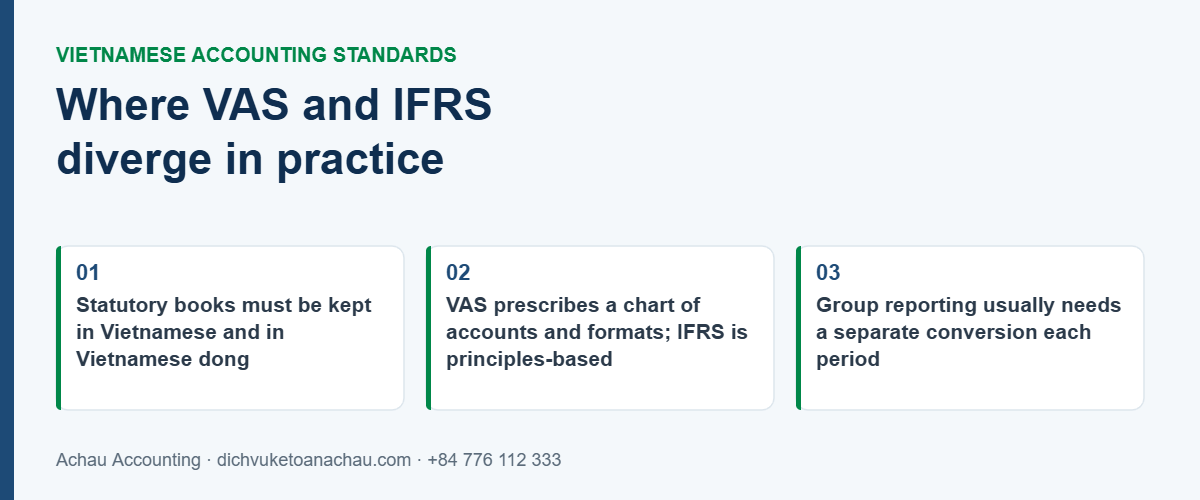
| Presentation Currency | VND only | Any functional currency | FDI companies with USD accounting must convert |
| Fixed Assets | Historical cost with prescribed depreciation | Cost or revaluation model; component depreciation | Higher depreciation expense possible under IFRS |
| Inventory | Lower of cost or NRV; FIFO/weighted avg | Same principle but LIFO prohibited | Minor differences in practice |
| Provisions | Specific guidance (Circular 48/2019); restrictive | IAS 37: broader recognition criteria | Fewer provisions under VAS → higher reported profit |
| Leases | Operating vs. finance (Circular 200) | IFRS 16: all leases on balance sheet | Significant difference — VAS shows lower liabilities |
| Revenue | Rules-based (VAS 14) | IFRS 15: 5-step model | Timing differences for complex contracts |
| Financial Instruments | Limited guidance | IFRS 9: classification, measurement, impairment | IFRS is significantly more detailed |
For the adjustments that move profit most (leases, revenue timing, credit losses, depreciation) and a monthly routine for running VAS books alongside IFRS group reporting, see our guide to Vietnam accounting standards vs IFRS: practical differences.
Latest 2026 Updates Foreign Businesses Should Know
1. Circular 152/2025/TT-BTC — New Accounting Regime for Household Businesses
Effective from the 2026 tax period, Circular 152/2025/TT-BTC introduces new simplified accounting forms (S1a-HKD through S3a-HKD) for household businesses. While this primarily affects household businesses, foreign companies that transact with or supply to household businesses should be aware that their counterparties now have standardized record-keeping requirements — improving the reliability of your Vietnamese supply chain documentation.
2. Decree 141/2026/ND-CP — Revised Tax Thresholds for Small Businesses
Raises the VAT/CIT exemption threshold to 1 billion VND in annual revenue (from the previous 100-300 million VND range). Foreign companies purchasing from small Vietnamese suppliers should verify their suppliers’ tax status, as those under the threshold are not required to issue VAT invoices — which affects your input VAT credit.
3. E-Invoice System Upgrade (Phase 2, 2026)
The General Department of Taxation is implementing Phase 2 of the e-invoice system, requiring real-time data transmission for all invoices. Companies using batch transmission should upgrade their systems to comply with the new real-time requirement.
Get Your Vietnamese Books VAS-Compliant Today
Á Châu Accounting has maintained VAS-compliant books for 1,000+ enterprises since 2008, including FDI companies, joint ventures, and representative offices. We handle everything: chart of accounts setup, monthly bookkeeping, e-invoice management, tax declarations, and financial statement preparation — all in English.
📞 Hotline: +84 776 112 333 | ✉️ Email: info@dichvuketoanachau.com
Continue exploring:
- Tài Chính Á Châu — Corporate Accounting & Compliance — deeper dives into financial reporting, audit preparation, and regulatory updates
- BIZCA — Vietnam Business Resources — legal updates, tax policy changes, and business networking
- Kế Toán Á Châu (.vn) — Local Language Resource Hub — Vietnamese-language guides, templates, and service details
Frequently Asked Questions
Can my foreign company use IFRS for statutory reporting in Vietnam?
No. Statutory financial statements must be prepared under VAS. However, you can prepare IFRS-based management accounts for internal use and group consolidation. The most common approach is to maintain VAS-compliant books and prepare IFRS adjustments for your parent company.
What happens if I don’t follow the mandatory chart of accounts?
The tax authority’s electronic filing system (HTKK) is built around the prescribed chart of accounts. A non-standard chart of accounts will cause your electronic tax declarations to be rejected, and your financial statements will not be accepted. Your accounting firm can remap a non-standard chart to the prescribed format.
Do I need a Vietnamese CPA to sign my financial statements?
Yes. The chief accountant (Ke toan truong) who signs your financial statements must hold a valid Chief Accountant Certificate issued by the Ministry of Finance or a recognized professional body. If you outsource your accounting, the service provider’s chief accountant signs. For FDI companies, an independent audit by a licensed Vietnamese auditing firm is also required before financial statements are submitted.
How much does outsourced accounting cost for a small FDI company?
Monthly fees range from 5,000,000 to 15,000,000 VND (~200-650 USD) depending on transaction volume, number of employees, and whether you need additional services like payroll or CFO advisory. This is typically 55-80% less than hiring an in-house accountant with equivalent expertise.
Are there any new accounting requirements for 2026 I should know about?
The key changes are: (1) Circular 152/2025/TT-BTC for household businesses (indirectly affecting your supply chain documentation), (2) the ongoing Phase 2 e-invoice upgrade requiring real-time transmission, and (3) the CIT provisional payment rule requiring Q1-Q3 payments to be at least 80% of the final annual CIT liability — underpayment triggers late payment interest of 0.03%/day.
Official sources: Vietnam Laws (VBPL) · Thu Vien Phap Luat · Ministry of Finance
Related Guides
- Accounting & bookkeeping review: are you audit-ready?
- FDI audit readiness checklist
- Choosing an accounting services company in Vietnam
- Accounting and bookkeeping services in vietnam
- Tax consulting services in vietnam
Related services
- Full-service accounting in Vietnam
- Corporate tax finalization service
- Tax consulting
- FDI and transfer pricing tax advisory
- Tax risk management advisory
Achau Accounting · 343 Pham Ngu Lao, Ben Thanh Ward, Ho Chi Minh City · +84 776 112 333 · linhcskh@dichvuketoanachau.com
More English guides: Accounting and tax guides for foreign companies in Vietnam — CIT, VAT, foreign contractor tax, payroll, e-invoicing and transfer pricing.
Á Châu khảo sát hồ sơ thực tế rồi tư vấn theo đúng tình hình của doanh nghiệp, không tư vấn theo quy định chung. Khảo sát sơ bộ không tính phí.
Gọi 0776 112 333Gửi yêu cầu tư vấn
Tra cứu nhanh: 30 câu hỏi thường gặp · Cẩm nang kế toán và thuế · Thư viện văn bản pháp luật
Need this handled for your company in Vietnam?
Three fields. An English-speaking adviser calls back within 4 working hours and sends a written quote within 24 hours. Bookkeeping from VND 500,000/month, priced on actual invoice volume.

