


Many foreign business owners in Vietnam operate under a dangerous assumption: “My accountant says everything is fine.” The reality is that bookkeeping errors accumulate silently — until a tax audit, a bank loan application, or an investor due diligence uncovers them. By then, the cost of fixing is exponentially higher than the cost of prevention.
This guide explains why and how to conduct an accounting bookkeeping review in Vietnam, the 10 warning signs your books need attention, and what a professional review process looks like.
10 Warning Signs Your Books Need an Immediate Review
- Your VAT input doesn’t match the tax authority’s system: When you log into iTaxViewer or HTKK, if your declared input VAT doesn’t match what the system shows from your suppliers, you have a problem. A single mismatch can block your entire VAT refund.
- Bank balance in your books ≠ actual bank balance: Reconciling bank statements monthly is non-negotiable. If your GL bank balance doesn’t match the actual bank statement, you’re flying blind.
- You have “suspense” or “temporary” accounts with balances: Any account labeled “tạm ứng”, “phải trả khác”, or “phải thu khác” with balances over 3 months is a red flag. These are often catch-alls for transactions the accountant didn’t know how to classify.
- Fixed asset depreciation doesn’t match the asset register: Under Circular 45/2013/TT-BTC, depreciation rates are prescribed. If your accountant is using different rates or hasn’t updated the register, your CIT liability may be wrong.
- Payroll costs don’t reconcile with PIT declarations and social insurance: The tax authority cross-references: total salaries in P&L vs. PIT declarations vs. social insurance registration base. Any discrepancy is an automatic audit flag.
- Foreign currency transactions are recorded at inconsistent rates: VAS requires consistent application of the actual transaction rate or BIDV’s published rate (Circular 200/2014/TT-BTC Art.69). Switching between methods without documentation creates forex gain/loss errors.
- You’re missing e-invoices for purchases over 20 million VND: Without a valid e-invoice AND bank transfer proof, the expense is non-deductible for CIT and the input VAT is not creditable. This is one of the most common findings in tax audits.
- Related-party transactions are not separately tracked or documented: All transactions with related parties must be identified, priced at arm’s length, and reported (Forms 01 & 02). Failure to do so = automatic transfer pricing audit risk.
- Your chart of accounts doesn’t follow Circular 200 or 133: A non-standard chart of accounts makes it impossible for the tax authority’s system to classify your data — triggering manual review and potential reclassification of expenses.
- You haven’t done a physical inventory count in over 12 months: Under VAS 02 (Inventory), an annual physical count is required. Discrepancies must be adjusted and documented. Without it, your balance sheet is unreliable.
The 3-Phase Professional Bookkeeping Review Process
Phase 1: Diagnostic Review (1-2 weeks)
A professional accounting firm reviews the last 12 months of your books systematically:
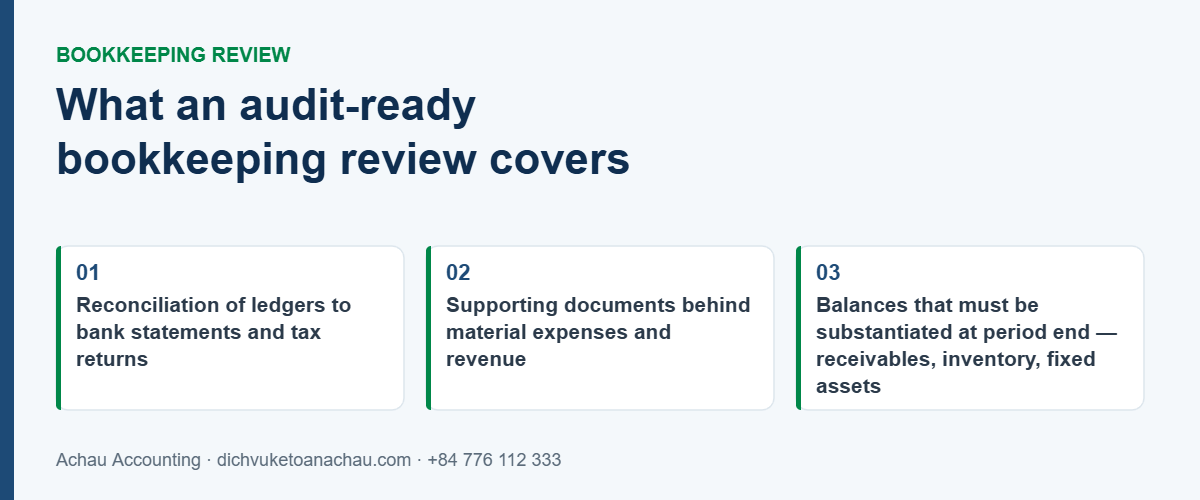
- Reconcile all bank accounts, cash, and inter-company balances
- Cross-check VAT input/output against the tax authority’s database
- Verify payroll, PIT, and social insurance for consistency
- Review the chart of accounts for compliance with Circular 200 or 133
- Check fixed asset register vs. GL vs. physical assets
- Sample-test expenses for valid supporting documents
- Identify foreign currency accounting issues
- Flag related-party transactions and transfer pricing exposure
Deliverable: A diagnostic report listing every issue found, classified by severity (Critical / High / Medium / Low), with quantified impact on tax liability where applicable.
Phase 2: Remediation (2-6 weeks depending on severity)
For each issue identified:
- Prepare adjusting journal entries with full supporting documentation
- Reconstruct missing records (invoices, contracts, payroll records)
- Prepare amended tax declarations if underpayment is identified
- Standardize the chart of accounts and accounting policies
- Set up proper books and records going forward
Deliverable: Clean, reconciled books ready for audit, loan application, or investor due diligence.
Phase 3: Preventive Controls Setup (1 week)
After remediation, implement systems to prevent recurrence:
- Monthly reconciliation checklist and calendar
- Standardized chart of accounts and accounting policy manual
- Document management system for invoices, contracts, and bank statements
- Quarterly internal review process
Need this handled for you? Á Châu provides accounting and bookkeeping services in Vietnam for foreign-invested and Vietnamese companies — statutory filings, reporting and inspection support. Call 0776 112 333.
Cost of a Bookkeeping Review vs. Cost of Not Reviewing
| Scenario | Estimated Cost |
|---|---|
| Professional bookkeeping review (12 months of books) | 15,000,000 – 40,000,000 VND (depending on volume) |
| Tax audit penalty — underdeclared CIT (average SME case) | 50,000,000 – 300,000,000+ VND |
| Disallowed VAT credit (single quarter, missed invoices) | 20,000,000 – 500,000,000+ VND |
| Failed bank loan application (due to unreliable financials) | Opportunity cost of delayed/denied funding |
| Failed investor due diligence | Deal collapse — potentially billions in lost investment |
The math is clear: a review costs a fraction of the potential downside.
VAS Compliance: The 5 Non-Negotiables
- Accounting records must be in Vietnamese Dong (VND). Foreign currency transactions must be converted at the actual exchange rate or BIDV rate, consistently applied. Dual-currency books (VND + USD) are permitted but the statutory record is VND.
- All records must be kept for at least 10 years under the Law on Accounting 2015 (amended 2024). This includes invoices, contracts, bank statements, tax declarations, and financial statements.
- E-invoices with tax authority codes are mandatory for all enterprises under Decree 123/2020/ND-CP. Paper invoices are no longer valid.
- Financial statements must follow VAS format (Circular 200/2014/TT-BTC for enterprises, Circular 133/2016/TT-BTC for SMEs). The chart of accounts is mandatory, not optional.
- Tax declarations must be filed on time: VAT monthly by the 20th of the following month; CIT quarterly provisional by the 30th of the following quarter; annual CIT finalization by March 31; PIT by the 20th (monthly) or 30th (quarterly).
If your parent reports under IFRS, keep the statutory books on VAS and bridge the difference in a separate reconciliation; our guide to Vietnam accounting standards vs IFRS sets out the adjustments that matter.
Not Sure If Your Books Are Clean?
Á Châu Accounting offers a Diagnostic Bookkeeping Review: we examine your last 12 months of accounting records, identify every issue with quantified impact, and deliver an actionable remediation plan — all in 2 weeks or less.
📞 Hotline: +84 776 112 333 | ✉️ Email: info@dichvuketoanachau.com
Official sources: Vietnam Legal Database · Ministry of Finance
Related resources:
- Tài Chính Á Châu — Financial Due Diligence & Restructuring for investor readiness and M&A preparation
- BIZCA Service Hub — Business Services Network for legal, tax, and compliance services
Frequently Asked Questions
How often should a company review its books?
At minimum: (1) monthly bank reconciliation, (2) quarterly VAT input/output reconciliation with the tax authority’s system, and (3) annual comprehensive review before financial statement finalization. If you’ve never had an external review, get one immediately — accumulated errors compound over time.
What’s the difference between a bookkeeping review and an audit?
A statutory audit is required only for FDI companies and certain other enterprises under the Law on Independent Audit. It provides reasonable assurance that financial statements are free of material misstatement. A bookkeeping review is a diagnostic service — it identifies specific errors, quantifies their tax impact, and provides remediation. Reviews can be done at any time and are typically faster and less expensive than audits.
Can I fix bookkeeping errors from previous years?
Yes. You can file amended tax declarations for previous periods. If you voluntarily correct before the tax authority discovers the error, the penalty is 20% of the underpaid tax. If the tax authority discovers it first, penalties are 1-3 times the tax amount. Always correct errors proactively.
Do I need a local Vietnamese accountant or can my overseas team handle it?
Vietnamese accounting must be done under VAS in VND by someone who understands local regulations. Your overseas team can handle IFRS consolidation, but the statutory books must be maintained in Vietnam by a qualified person (at minimum, someone with a Vietnamese accounting certificate). Most FDI companies outsource this to a local accounting firm.
Related Guides
- Vietnam Accounting Standards (VAS) & bookkeeping
- FDI audit readiness checklist
- Accounting services company in Vietnam
- Accounting and bookkeeping services in vietnam
- Tax consulting services in vietnam
- Chief accountant requirement in Vietnam: who qualifies
- Choosing an accounting firm in Vietnam: 12 questions to ask
Related services
- Full-service accounting in Vietnam
- Corporate tax finalization service
- Tax consulting
- FDI and transfer pricing tax advisory
- Tax risk management advisory
Achau Accounting · 343 Pham Ngu Lao, Ben Thanh Ward, Ho Chi Minh City · +84 776 112 333 · linhcskh@dichvuketoanachau.com
More English guides: Accounting and tax guides for foreign companies in Vietnam — CIT, VAT, foreign contractor tax, payroll, e-invoicing and transfer pricing.
Á Châu khảo sát hồ sơ thực tế rồi tư vấn theo đúng tình hình của doanh nghiệp, không tư vấn theo quy định chung. Khảo sát sơ bộ không tính phí.
Gọi 0776 112 333Gửi yêu cầu tư vấn
Tra cứu nhanh: 30 câu hỏi thường gặp · Cẩm nang kế toán và thuế · Thư viện văn bản pháp luật
Need this handled for your company in Vietnam?
Three fields. An English-speaking adviser calls back within 4 working hours and sends a written quote within 24 hours. Bookkeeping from VND 500,000/month, priced on actual invoice volume.

