


Access to capital remains one of the top challenges for small and medium enterprises in Vietnam — both local and foreign-invested. While Vietnam’s banking sector has expanded significantly, with over 40 commercial banks and growing fintech lending platforms, loan approval rates for SMEs hover around 35-40%, largely because of inadequate financial documentation.
This guide walks you through how to prepare a bank-ready loan dossier, what Vietnamese banks look for, current interest rates, and alternative financing options in 2026.
The 5 Steps to a Bank-Ready Loan Application
Step 1: Prepare Audited (or Reviewed) Financial Statements
This is the single most important document. Vietnamese banks require at minimum:
- Last 2-3 years of financial statements (Balance Sheet, Income Statement, Cash Flow Statement)
- Ideally audited by an independent auditing firm — not required for all loan sizes but significantly increases credibility
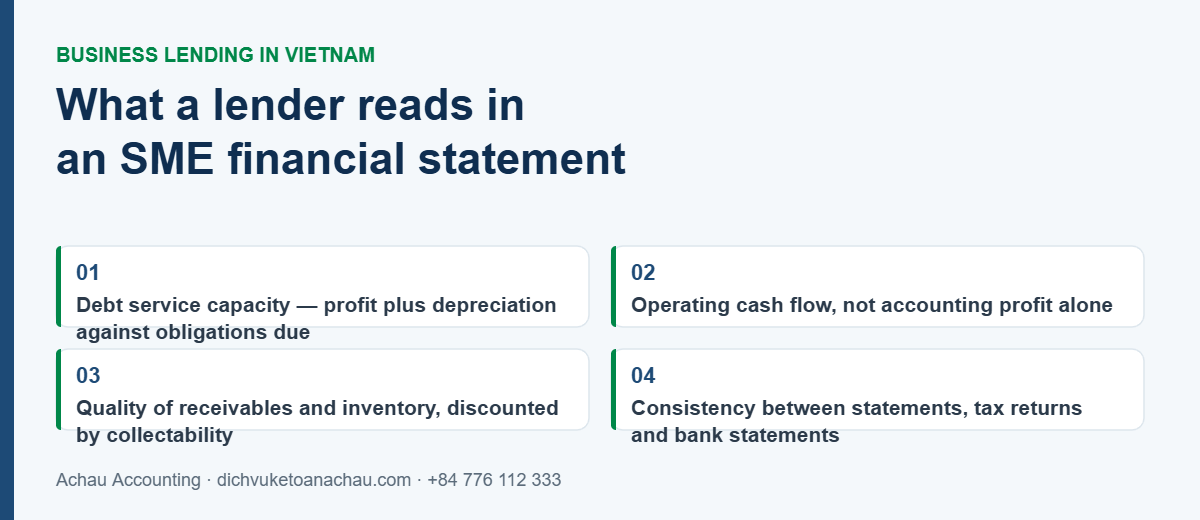
- Clear demonstration of profitability, positive cash flow, and manageable debt levels
- All tax liabilities must be settled (tax clearance certificate is often requested)
Red flags that banks watch for: negative equity, accumulated losses, inconsistent revenue patterns, large related-party receivables, and tax arrears.
Step 2: Build a Realistic Business Plan with Financial Projections
A credible business plan should include:
- Loan purpose: Be specific — working capital, equipment purchase, factory expansion, or debt restructuring
- 3-year financial projections: Revenue forecast (with assumptions), cost structure, projected P&L, cash flow forecast, and debt service schedule
- Market analysis: Target customers, competitive advantage, growth strategy
- Repayment plan: Clear demonstration of ability to service the loan (DSCR — Debt Service Coverage Ratio — should exceed 1.25x)
Step 3: Assemble Collateral Documentation
Vietnamese banks are conservative — most SME loans require collateral. Acceptable forms:
| Collateral Type | Typical Loan-to-Value Ratio |
|---|---|
| Real estate (land use rights, property) | 60-80% |
| Machinery & equipment | 30-50% |
| Inventory | 30-50% |
| Accounts receivable | 50-70% (with credit insurance) |
| Bank deposits / certificates of deposit | 90-100% |
| Third-party guarantee | Varies |
For FDI companies, banks may accept parent company guarantees, particularly for well-established multinational groups.
Step 4: Prepare Cash Flow Documentation
Banks want to see that your business generates enough cash to service the loan. Prepare:
- Last 6-12 months of bank statements (both business and personal accounts of owners)
- Accounts receivable aging report: Shows who owes you money and how collectible those receivables are
- Accounts payable schedule: Your payment obligations
- Sales contracts or purchase orders: Evidence of confirmed future revenue
Step 5: Obtain Tax Clearance
Most banks will request a tax clearance certificate (Xac nhan hoan thanh nghia vu thue) from the tax authority. This confirms:
- All tax declarations have been filed
- All assessed taxes have been paid
- No outstanding tax disputes or audits
If you have tax arrears, resolve them before applying — banks view unpaid taxes as a major credit risk.
Current Interest Rates in Vietnam (2026)
| Loan Type | Typical Interest Rate (p.a.) | Typical Term |
|---|---|---|
| Short-term working capital (VND) | 6.0% – 9.0% | 6-12 months |
| Medium-term investment loan (VND) | 8.0% – 11.0% | 1-5 years |
| Long-term project finance (VND) | 9.5% – 12.5% | 5-10 years |
| USD-denominated loans (short-term) | 3.5% – 5.5% | Up to 12 months |
| Export financing / trade finance | 4.0% – 7.0% | Per shipment |
| Credit Guarantee Fund (VBSP-backed) | 5.0% – 7.0% | 1-3 years |
Note: Most rates are floating, based on the bank’s base rate + spread. After the initial fixed-rate period, rates adjust quarterly. Always ask for the “all-in” rate including fees.
Need this handled for you? Á Châu provides accounting and bookkeeping services in Vietnam for foreign-invested and Vietnamese companies — statutory filings, reporting and inspection support. Call 0776 112 333.
Why SME Loan Applications Get Rejected
- Inadequate financial records — No proper bookkeeping, missing financial statements, or unaudited books
- Insufficient cash flow — DSCR below 1.2x, inconsistent revenue, or excessive owner withdrawals
- Over-leveraged — Existing debt-to-equity ratio too high (banks typically look for <3:1 for SMEs)
- Poor collateral quality — Land with unclear title, outdated equipment, or collateral already pledged elsewhere
- Tax non-compliance — Outstanding tax liabilities, unfiled declarations, or ongoing audits
- Industry risk — Banks have sector concentration limits and may restrict lending to high-risk industries (real estate speculation, cryptocurrency, gambling-related)
Alternative Financing Options in Vietnam
1. Credit Guarantee Fund for SMEs
The Vietnam Development Bank (VDB) and provincial Credit Guarantee Funds provide partial guarantees (50-70%) for SME loans. Requirements are more flexible than commercial banks, but processing time is longer (1-3 months).
2. Fintech & P2P Lending
Platforms like Validus, Tima, and Finhay have entered the SME lending space with faster approval (2-7 days) and lower documentation requirements. Interest rates are higher (12-20% p.a.) but suitable for short-term working capital.
3. Supply Chain Financing
If you are a supplier to large corporations or multinationals, supply chain financing allows you to get advance payment against confirmed purchase orders or invoices. Rates are typically 8-15% p.a.
4. Equity Financing
For growth-stage companies, Vietnam’s venture capital and private equity ecosystem is maturing. Consider equity investment instead of debt if your business has high growth potential and you’re willing to share ownership.
Need Help Preparing Bank-Ready Financials?
Á Châu Accounting prepares audit-ready financial statements, cash flow projections, and comprehensive loan application dossiers for SMEs. We also connect qualified businesses with our network of banking partners.
📞 Hotline: +84 776 112 333 | ✉️ Email: info@dichvuketoanachau.com
Official sources: State Bank of Vietnam · Credit Information Center (CIC)
Explore our financial ecosystem:
- Tài Chính Á Châu — Corporate Finance & Loan Advisory — loan dossier preparation, bank matching, and financial restructuring for SMEs
- BIZCA Capital Hub — SME Funding & M&A — access capital, find investors, and explore M&A opportunities
Frequently Asked Questions
Can a foreign-owned company in Vietnam get a bank loan?
Yes. FDI companies can borrow from Vietnamese banks, but requirements are stricter. Banks typically require: (1) the company to have been operating profitably for at least 1-2 years, (2) collateral in Vietnam (unless parent company guarantee is available), and (3) all tax obligations to be current. Some banks have specific FDI lending desks with English-speaking officers.
How long does it take to get a business loan approved in Vietnam?
For loans under 5 billion VND with full collateral, approval typically takes 2-4 weeks. Larger loans (5-50 billion VND) can take 4-8 weeks. Fintech platforms can approve in 2-7 days for smaller amounts (under 500 million VND).
Do I need audited financial statements for a bank loan?
For loans under 3 billion VND, reviewed or internally prepared financial statements may suffice. For larger loans, particularly from foreign banks or joint-stock commercial banks, audited financial statements are strongly preferred. Banks will always request at least 2 years of financial data.
What is the minimum credit score for an SME loan in Vietnam?
Vietnam does not have a universal SME credit scoring system like the U.S. However, the Credit Information Center (CIC) under the State Bank of Vietnam maintains credit histories. A clean CIC report (no past-due loans, no defaults) is essential. Banks also assess qualitative factors: management experience, industry outlook, and relationship history.
🔗 Khám phá thêm trong hệ sinh thái Á Châu:
- Dịch Vụ Kế Toán Á Châu (.vn) — Dịch vụ kế toán trọn gói
- Tài Chính Á Châu — Tư vấn tài chính doanh nghiệp, vay vốn
- BIZCA — Kết nối kinh doanh, M&A, gọi vốn
Nguồn tham khảo pháp lý: Thư Viện Pháp Luật · VBPL
Related Guides
- Vietnam Accounting Standards (VAS) & bookkeeping
- Financial advisory company in Vietnam
- Choosing an accounting services company in Vietnam
- Accounting and bookkeeping services in vietnam
- Tax consulting services in vietnam
Related services
- Full-service accounting in Vietnam
- Corporate tax finalization service
- Tax consulting
- FDI and transfer pricing tax advisory
- Tax risk management advisory
Achau Accounting · 343 Pham Ngu Lao, Ben Thanh Ward, Ho Chi Minh City · +84 776 112 333 · linhcskh@dichvuketoanachau.com
More English guides: Accounting and tax guides for foreign companies in Vietnam — CIT, VAT, foreign contractor tax, payroll, e-invoicing and transfer pricing.
Á Châu khảo sát hồ sơ thực tế rồi tư vấn theo đúng tình hình của doanh nghiệp, không tư vấn theo quy định chung. Khảo sát sơ bộ không tính phí.
Gọi 0776 112 333Gửi yêu cầu tư vấn
Tra cứu nhanh: 30 câu hỏi thường gặp · Cẩm nang kế toán và thuế · Thư viện văn bản pháp luật
Need this handled for your company in Vietnam?
Three fields. An English-speaking adviser calls back within 4 working hours and sends a written quote within 24 hours. Bookkeeping from VND 500,000/month, priced on actual invoice volume.

